What Is Technology Advisory and Why Enterprise Leaders Hire Independent Consultants Before Making Platform Decisions
The technology consulting market is forecast to surpass $400 billion in 2026. 94% of technology clients expect to increase their spending on digital technologies in the next 18 months.
Those numbers reflect something specific happening inside enterprise organizations. The decisions that determine technology spend have become more consequential, more complex, and more difficult to evaluate with internal expertise alone. Choosing between cloud platforms, selecting a DevSecOps toolchain, committing to a CRM architecture, or deciding which workloads to migrate and in what sequence are decisions that carry multi-year financial implications. Getting them wrong does not just waste the budget on a bad tool. It produces technical debt that compounds, operational debt that grows, and organizational debt that requires a future program to unwind.
Firms positioned as technology-neutral advisors are pulling ahead of those perceived as aligned with specific vendors. Boards are mandating AI readiness assessments, regulatory bodies are demanding model governance documentation, and CFOs are pushing for measurable ROI frameworks before approving technology spend. Each of these creates a distinct advisory engagement that clients cannot fully execute internally.
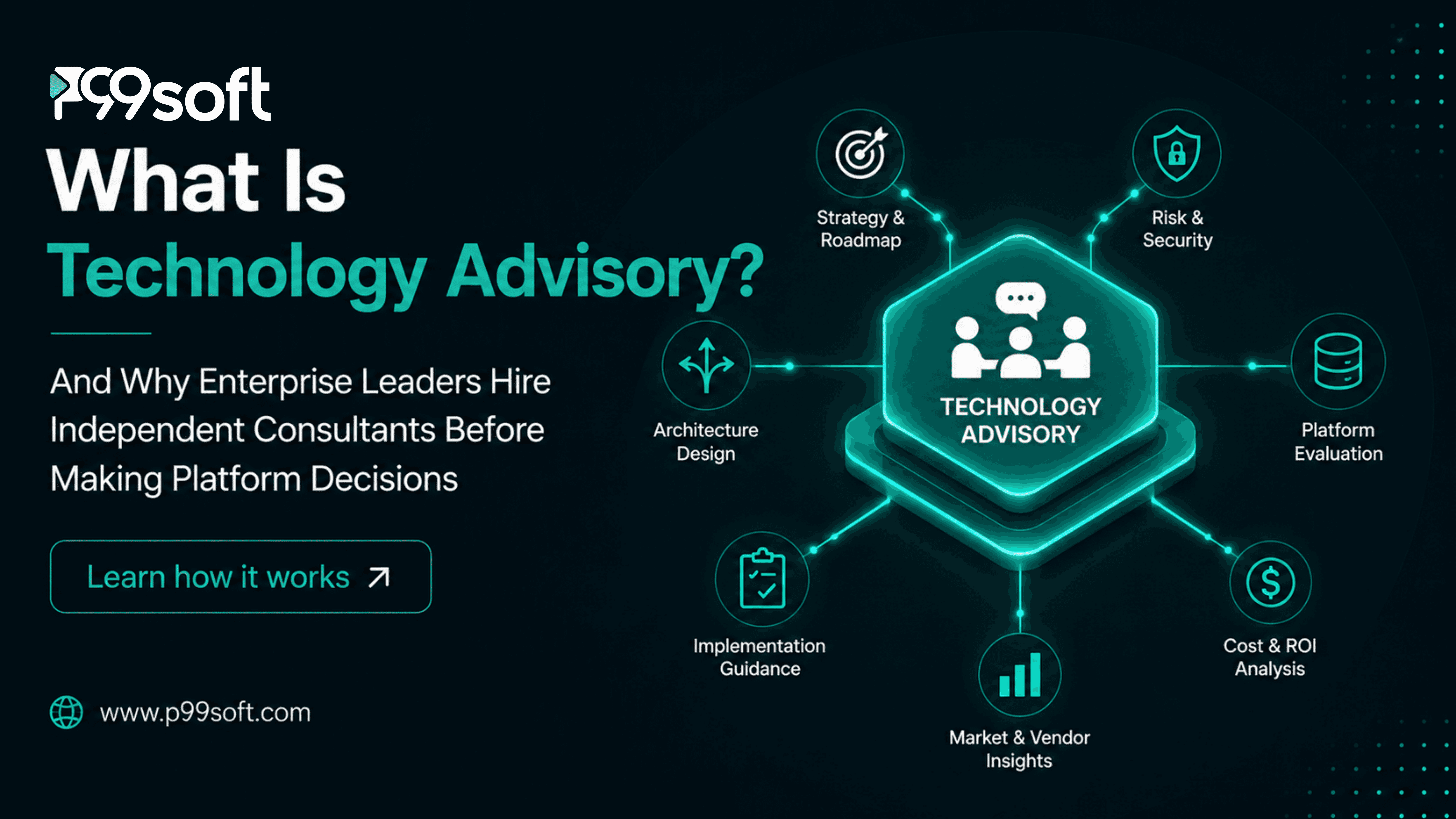
Technology advisory is the engagement model that addresses this specific gap. Not the gap in building capability or operating systems. The gap in evaluating options, structuring decisions, and building the financial and organizational case for technology investments before the commitment is made.
What Technology Advisory Actually Is
Technology advisory is the practice of providing independent, vendor-neutral guidance on technology strategy and platform decisions. It is distinct from implementation consulting in one critical way: the deliverable is a decision and a plan, not a working system.
The IT Consulting and Implementation market refers to advisory services provided by professionals and firms that help businesses evaluate their technology strategies and align them with their business strategies or internal processes.
An implementation consultant works on the technology after the decision is made. An advisor works on the decision itself. The two engagements are complementary and often sequential: advisory informs the platform selection and program design, implementation executes against the plan the advisory produced.
The types of decisions that most commonly require external advisory input fall into four categories. Platform selection, where an organization needs an independent assessment of competing vendors or architectures before committing to a multi-year investment. Program design, where a migration, modernization, or transformation program needs to be structured before internal teams execute it. Build versus buy, where the organization needs to evaluate whether to develop a capability internally or acquire it through a product or managed service. Vendor negotiation, where an independent technical voice is needed to evaluate what a vendor is promising against what is actually deliverable.
Each of these requires the same thing: a technically credible perspective that is not aligned with the outcome of any specific decision. An internal engineering team that has spent three years building expertise on a specific platform will approach a platform evaluation with a set of assumptions that an advisor can surface and challenge. A vendor's solutions engineer will present the platform evaluation with a set of incentives that an advisor can account for. Neither the internal team nor the vendor is being dishonest. Both are presenting the evaluation through a frame that an independent advisor is not constrained by.
Technology advisory is not a substitute for internal technical expertise. It is a complement to it. The internal team knows how to build and operate systems. The advisor knows how to evaluate options and structure decisions. The combination produces better decisions than either produces independently.
When Enterprise Leaders Hire Independent Technology Advisors
The trigger for an advisory engagement is almost always one of three conditions: a decision is too large to get wrong, the internal team lacks the breadth of exposure needed to evaluate all options credibly, or the political dynamics inside the organization require an independent voice to break a deadlock.
The decision is too large to get wrong. A core banking platform migration, an enterprise cloud strategy, a DevSecOps platform consolidation, or a major CRM implementation are decisions that carry five to ten year implications. The cost of a wrong decision is not just the budget spent on the wrong platform. It is the migration program required to move off it, the productivity lost while using a platform that does not fit the organization's needs, and the opportunity cost of features and capabilities that were not built because the wrong platform was constraining them. For decisions at this scale, the cost of advisory is small relative to the cost of the decision going wrong.
The internal team lacks breadth of exposure. A team of exceptional engineers who have built and operated a specific platform for several years may have limited visibility into the full landscape of alternatives. This is not a limitation of their technical capability. It is a natural consequence of deep specialization. An advisor who has evaluated the same category of platform across dozens of organizations at different scales and in different industries brings the comparison context that internal expertise does not produce.
AI is now the biggest driver of consulting demand. Companies are hiring consultants not just to design AI strategy but to implement, scale, and govern AI across organizations. Enterprises are moving past early-stage generative AI pilots and shifting focus toward embedded, agentic AI solutions that drive real-world business outcomes.
The AI advisory surge reflects exactly this dynamic. Most organizations have internal engineers who understand how to work with AI models. Very few have internal engineers who have evaluated AI platform options, designed AI governance frameworks, and built ROI models for AI investment across multiple industries and regulatory environments. That breadth of comparative exposure is what makes the advisor valuable.
The political dynamics require an independent voice. Technology decisions inside large organizations are rarely purely technical. They carry organizational stakes: which team's preferred platform wins, which leader's past decisions are validated or questioned, which budget owner's priorities take precedence. An internal advocate for a particular platform decision carries the political weight of their organizational position into the evaluation. An external advisor carries the credibility of independence. This is why advisory recommendations often move faster through approval processes than identical recommendations from internal teams.
What Technology Advisory Produces
An advisory engagement that produces real value has three outputs. Each is distinct, and understanding what to expect from each prevents the engagement from becoming a deliverable without impact.
A structured decision framework. The first output is a framework that makes the decision being evaluated explicit: what criteria matter, how they should be weighted, and what evidence satisfies each criterion. A platform selection without an explicit decision framework produces a recommendation that reflects the advisor's judgment without giving the organization the logic it needs to validate the recommendation, challenge assumptions, and defend the decision to other stakeholders.
A structured decision framework also produces the second-order benefit of organizational alignment. When the engineering leader, the CTO, the CFO, and the implementation team have all agreed on the evaluation criteria before the evaluation begins, the recommendation that emerges from applying those criteria to the options is significantly easier to accept than a recommendation that arrives without a shared framework underpinning it.
An honest cost model. The second output is a financial model that accounts for the full cost of each option over a meaningful horizon, including costs that vendor presentations consistently exclude. An advisory engagement that evaluates a cloud migration option, for example, includes the migration execution cost, the skills gap cost, the licensing change cost, and the optimization lag period alongside the infrastructure cost reduction benefit. The result is a model that produces a credible payback period rather than an optimistic projection that collapses under CFO scrutiny.
P99Soft's Advisory and Consulting practice builds these cost models as the primary deliverable of every advisory engagement, specifically designed to survive the financial review that determines whether the recommended program gets funded. For cloud and data migration programs, this connects directly to the Cloud and Data Migration practice where the advisory work transitions into program execution with a financial baseline already validated by finance.
A decision and a plan. The third output is the recommendation itself, expressed not as a vendor preference but as a program design: what to build or buy, in what sequence, with what organizational and technical prerequisites, and with what success metrics that allow the organization to measure whether the decision produced the outcome it was intended to produce.
A technology advisory engagement that ends with a report containing a recommendation but no program design has produced analysis, not advisory. The decision without the plan creates a gap between the recommendation and the execution that implementation teams frequently fill with assumptions that diverge from what the advisor intended.
The Difference Between Advisory and Implementation Consulting

Most enterprise technology programs involve both advisory and implementation consulting, and understanding the boundary between them prevents the specific failure mode where implementation begins before the advisory is complete.
Advisory answers the question of what to do and how to structure it. Implementation answers the question of how to build it. When implementation begins before advisory is complete, the implementation team builds toward a program design that has not been fully validated. The result is either scope changes mid-program when the advisory catches up to the implementation, or a completed implementation that does not align with the strategy the advisory was intended to inform.
Finding the right technology consulting partner is one of the more consequential decisions a business can make. The firm you choose will shape both the outcome and the experience of getting there.
The correct sequence is advisory first, then program design, then implementation. For major platform decisions, advisory is worth treating as a gate rather than a parallel workstream: the implementation program does not start until the advisory has produced the decision and the plan the implementation will execute against.
P99Soft's Advisory and Consulting practice positions every advisory engagement as the input to the implementation program rather than as a standalone analysis exercise. The connection between the advisory output and the implementation program is explicit: the decision framework, the cost model, and the program design that advisory produces become the scoping document, the financial baseline, and the success metrics for the implementation engagement that follows.
This sequencing applies across every service area. A Salesforce advisory engagement that evaluates configuration versus customization options, data migration requirements, and adoption prerequisites feeds directly into the CRM Implementation and Customization program that follows. An analytics advisory engagement that defines the BI foundation requirements, the analytics maturity target, and the data quality baseline feeds directly into the Analytics and Insights program that implements it.
What Makes an Independent Technology Advisor Actually Independent
Independence in technology advisory is more specific than it sounds. A consultant employed by a firm that has a preferred partner relationship with a specific cloud provider, a quota on a specific platform, or a practice area built around a specific technology is not independent with respect to evaluations that include that technology, regardless of how the engagement is described.
Firms positioned as technology-neutral advisors are pulling ahead of those perceived as aligned with specific vendors.
Genuine independence means the advisor's recommendation is determined by what fits the client's requirements rather than by what the advisor is positioned to implement, what the advisor is incentivized to recommend, or what the advisor's previous experience makes them most comfortable with.
The practical test for whether an advisory engagement is genuinely independent is whether the advisor will recommend a platform or approach that they cannot implement. An advisor who consistently recommends the technologies their implementation practice is built around is not conducting an independent evaluation. They are conducting a sales process with an advisory narrative.
This is one reason why the advisory practices that produce the most credible recommendations for enterprise clients are ones that have implementation capability across multiple platforms and the organizational willingness to recommend whichever platform genuinely fits the client's requirements, even when that recommendation creates work for a competitor rather than for themselves.
P99Soft's Advisory and Consulting practice is structured to recommend the right solution for the client's specific requirements rather than the solution that maximizes the firm's implementation opportunity. For organizations that need ongoing operational support after a platform decision is implemented, Managed Support Services provides the continuity of care that keeps the implemented solution performing to the standard the advisory projected, regardless of which platform the advisory recommended.
The Four Technology Decisions That Benefit Most From External Advisory
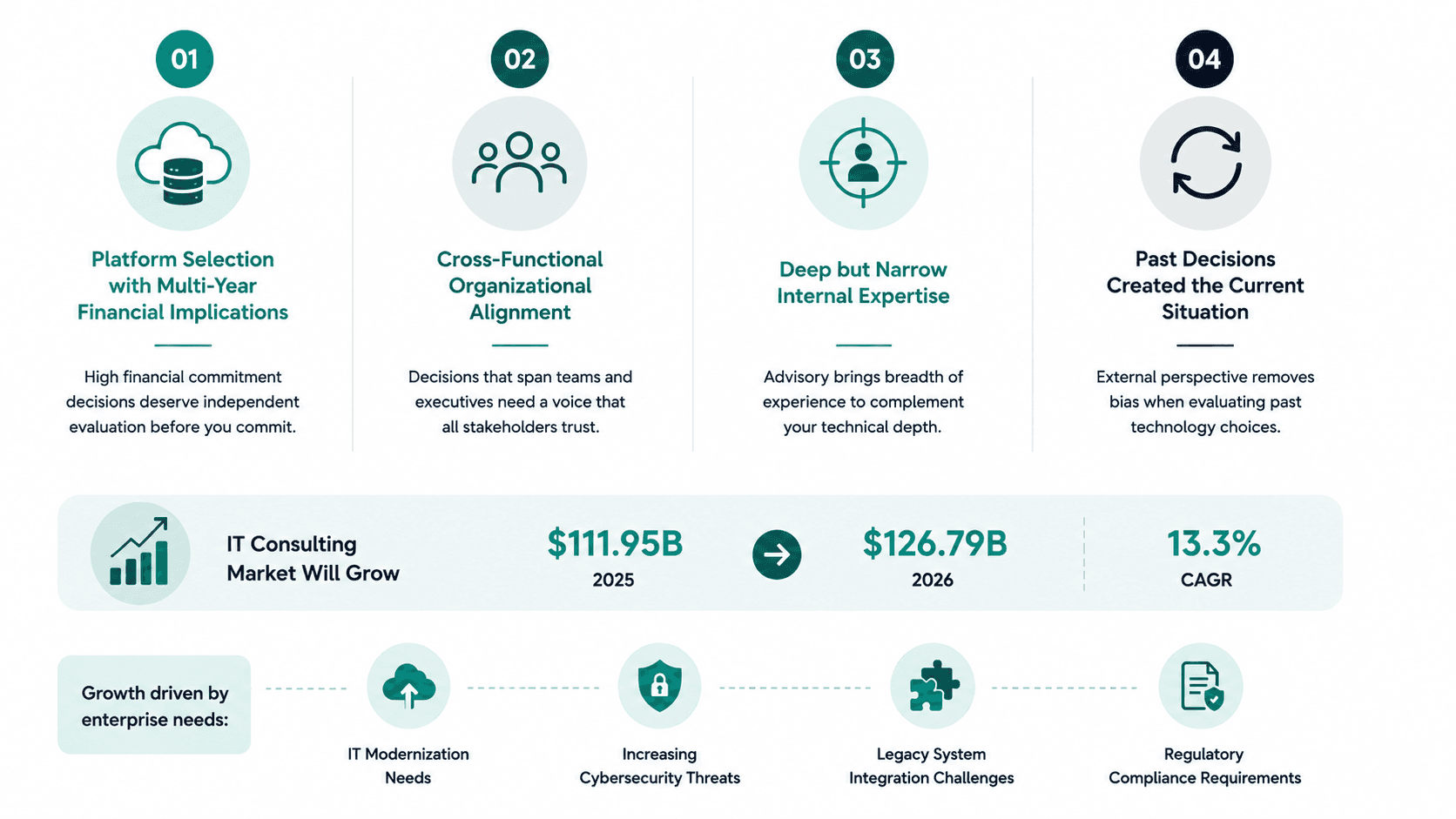
Not every technology decision warrants an external advisory engagement. The cost and time investment of advisory is justified when the decision has specific characteristics.
Platform selection with multi-year financial implications. Any platform decision that commits the organization to a significant annual spend over three or more years warrants an independent evaluation before the commitment is made. Cloud platform selection, enterprise software procurement, DevSecOps platform consolidation, and data platform architecture decisions are all in this category.
Programs requiring cross-functional organizational alignment. Technology decisions that require sign-off from multiple executives, that cross organizational boundaries between IT and business units, or that require both technical and financial validation benefit from an advisor who can present the recommendation with credibility to all stakeholder groups simultaneously. An internal engineering leader presenting a platform recommendation to the CFO brings the perception of technical advocacy. An external advisor presenting the same recommendation brings the perception of independence.
Decisions where internal expertise is deep but narrow. An engineering organization that has built exceptional expertise in a specific technology stack may lack the comparative exposure to evaluate alternatives credibly. Advisory supplements this depth with the breadth of comparative experience that deep specialization does not produce.
Programs where past decisions created the current situation. When an organization is evaluating whether to modernize or replace a system that was built under a previous technology leadership, the internal team faces the specific challenge of evaluating their own past decisions. An external advisor can conduct that evaluation without the organizational dynamics that make internal self-evaluation difficult.
The IT consulting market will grow from $111.95 billion in 2025 to $126.79 billion in 2026 at a CAGR of 13.3%. The growth is attributed to enterprise IT modernization needs, increasing cybersecurity threats, legacy system integration challenges, and regulatory compliance requirements.
All four of those growth drivers, modernization needs, cybersecurity complexity, legacy integration challenges, and compliance requirements, produce exactly the decision conditions where external advisory adds value. The market growth reflects organizations recognizing that the consequences of getting these decisions wrong are larger than the cost of getting independent advice on how to get them right.
FAQ
What is technology advisory consulting and how does it differ from IT consulting?
Technology advisory consulting is the engagement of an independent technical expert to help enterprise leaders evaluate options, build strategy, and structure high-stakes technology decisions before budget is committed. It differs from IT consulting in that the primary deliverable is a decision and a program design rather than a delivered system. IT consulting typically refers to implementation work where consultants build or configure technology. Advisory precedes implementation: it answers what to build and how to structure it, so that the implementation program has a validated foundation to execute against.
When should enterprise leaders hire an independent technology advisor?
Enterprise leaders should hire an independent technology advisor when the decision being made has multi-year financial implications that make the cost of a wrong choice significantly exceed the cost of advisory, when the internal team has deep expertise in specific technologies but limited comparative exposure to evaluate all available options, when the program requires executive alignment across multiple stakeholder groups with different priorities, or when the organization needs a vendor-neutral perspective that internal advocates for specific platforms cannot provide. The IT consulting market growing to $126.79 billion in 2026 reflects the scale at which organizations are recognizing these conditions in their own decision-making.
What does a technology advisory engagement actually deliver?
A technology advisory engagement delivers three outputs. A structured decision framework that makes the evaluation criteria explicit and agreed upon before the evaluation begins. An honest cost model that accounts for the full cost of each option over a three-year or longer horizon, including the costs that vendor presentations consistently exclude. And a recommendation expressed as a program design, not just a vendor preference, that includes the sequence, prerequisites, and success metrics the organization needs to execute the decision and measure whether it achieved its intended outcome. Advisory engagements that deliver only a recommendation without a program design produce analysis rather than advisory.
How do you evaluate whether a technology advisor is genuinely independent?
The practical test is whether the advisor will recommend platforms or approaches they cannot implement. An advisor whose recommendations consistently align with the technologies their implementation practice is built around is conducting a sales process with an advisory narrative rather than an independent evaluation. Genuine independence means the recommendation reflects what fits the client's requirements, even when that recommendation creates implementation work for a competitor. Firms that have broad implementation capability across multiple platforms and the organizational willingness to recommend any of them are more credibly independent than firms with a single-platform practice advising on platform selection.
Author Name - Mrunalini Wankhede