End-to-End System Testing: How to Validate Complex Systems Without a Brittle Test Suite

End-to-end system testing validates that a complete application works correctly from the user's perspective, across every integrated component, from interface to backend and back. The reason most E2E suites become brittle is design, not the technique: teams build too many tests covering every path through the UI, use fragile selectors, and share test data between tests. A reliable E2E suite stays small, covers only critical user journeys, uses stable selectors and isolated test data, and treats flaky tests as bugs to fix rather than noise to rerun.
A global retail team runs its overnight regression suite. Everything was stable last week. This morning, checkout flow tests are failing in batches. Nothing in the checkout module changed, yet the build is blocked. After hours of triage, the culprit turns out to be a small tweak in a shared authentication service that cascaded into dozens of failures across unrelated modules.
This situation happens across enterprises all the time, and it is the reason end-to-end testing has a reputation problem. The real issue is not the failure itself but the design choices that made the suite fragile in the first place.
The numbers confirm how widespread the problem is. Industry data suggests 15 to 25 percent of end-to-end tests exhibit flaky behavior, meaning they pass or fail inconsistently without any code changes. 1 in 3 testing leaders report that flaky automation is a primary blocker to QA productivity. Test maintenance, including fighting flakiness, consumes roughly 40 percent of QA team time, which is time not spent finding actual bugs.
Here is the part that matters: end-to-end testing remains indispensable. It is the only testing layer that validates the system actually works the way users experience it, across every integrated service. The challenge in 2026 is getting the benefit of E2E testing without it becoming the brittle, flaky bottleneck that drags down the delivery pipeline. The difference between a suite that delivers that benefit and one that becomes technical debt is not the framework. It is a small number of disciplined design decisions. This article covers them.
What End-to-End System Testing Actually Validates
End-to-end system testing validates whether an application behaves as expected from the user's perspective, exercising the entire application stack from the frontend through the backend and back.
This is fundamentally different from the lower testing layers. Unit tests verify isolated functions. Integration tests check that components communicate correctly. End-to-end tests validate the complete journey: a user logs in, navigates to a product, adds it to a cart, checks out, and receives confirmation, with every service that participates in that journey working together to produce the right outcome.
The unique value of E2E testing is that it catches the failures that only appear when the whole system operates together. A payment service that works perfectly in isolation and an inventory service that works perfectly in isolation can still fail when the checkout flow connects them, because the failure lives in the interaction rather than in either component. No amount of unit or integration testing detects this. Only end-to-end testing, exercising the real flow across the real integrated system, catches it.
This is also why E2E testing is inherently harder than the lower layers. E2E tests require a test environment that replicates the production stack, which can involve spinning up databases, services, message brokers, and more. In microservice architectures, the number of services that must run together can be large, and ensuring all dependencies including third-party APIs are available and configured is non-trivial. The very thing that gives E2E testing its value, exercising the complete integrated system, is the thing that makes it complex and fragile when done without discipline.
Key Takeaway: End-to-end system testing is the only layer that validates the system works the way users actually experience it, across every integrated component. Its value and its difficulty come from the same source: it exercises the complete real system rather than isolated pieces.
Why E2E Test Suites Become Brittle
Brittle E2E suites are not an inherent property of end-to-end testing. They are the result of specific, identifiable design mistakes. Understanding the mistakes is what makes them preventable.
Mistake one: testing everything through the UI. The most common mistake is trying to test every possible user path and edge case through the full UI, which leads to a bloated, flaky suite that provides diminishing returns. Teams build massive, tightly coupled test scripts that try to validate the entire user journey in one flow, depending on multiple services, real data, and long UI paths. These monolithic scenarios look comprehensive but collapse when any piece changes. An overreliance on E2E testing produces the dreaded inverted testing pyramid: few unit tests, even fewer integration tests, and a mountain of brittle, slow E2E tests at the top.
Mistake two: fragile selectors. A large portion of flakiness traces to how tests identify the UI elements they interact with. Brittle selectors like CSS classes that change during refactors, pixel coordinates, or fragile element hierarchies break whenever the layout changes. Stable, semantic selectors are the single highest-leverage decision in E2E reliability: identifiers like data-testid and ARIA-role locators outlive CSS class refactors and survive the UI changes that break fragile selectors.
Mistake three: shared and static test data. When tests share databases or test data, they interfere with each other. One test leaves a record changed or a session open, and the next test inherits that state and behaves differently than it would in a clean setup. Shared or static test data causes false results that look like bugs but are actually contamination between tests.
Mistake four: improper waiting. The largest single category of flakiness is timing. Asynchronous wait issues account for roughly 45 percent of flaky tests, where the test does not wait properly for an operation to complete before checking its result. Tests that use fixed sleep commands rather than dynamic waits either fail when the operation takes longer than the sleep or waste time when it completes faster.
Mistake five: no ownership. Most enterprise E2E challenges emerge when responsibilities are unclear or ownership is scattered. Without an owner responsible for keeping a flow's tests healthy, brittle tests accumulate, nobody retires obsolete ones, and the suite decays into something the team works around rather than trusts.
These five mistakes compound. A large suite of UI tests with fragile selectors, shared data, and improper waiting, owned by nobody, produces exactly the brittle, flaky bottleneck that gives E2E testing its bad reputation. P99Soft's End-to-End System Testing practice is built around preventing these five mistakes by design, producing suites that stay reliable as the system evolves rather than degrading into maintenance burdens.
The Foundation: Test Only Critical User Journeys
The single most important decision in building a reliable E2E suite is restraint: testing only the critical user journeys the business cannot ship without, rather than attempting exhaustive coverage through the UI.
The pyramid economics have not changed. E2E tests are slow, expensive to maintain, and more failure-prone than unit or integration tests, so they should make up the smallest layer, typically 5 to 10 percent of total test count, and target only the critical paths the business cannot ship without. For most products, the right number of E2E tests lands between 20 and 200, enough to cover every critical user journey and no more.
This restraint is counterintuitive because it feels like less coverage is worse. The opposite is true. A focused suite of E2E tests covering the critical journeys, backed by a strong foundation of fast unit and integration tests, catches more defects more reliably than a bloated E2E suite attempting to cover everything. Organizations using a well-structured test pyramid reduce test suite run times by up to 80 percent while catching more defects earlier, because the defects get caught at the fast, stable lower layers rather than the slow, flaky top layer.
The discipline is to push testing down the pyramid wherever possible. Testing complex business logic through the full UI stack is overkill that adds overhead and slows execution without improving quality. Business rules and calculations should be tested at the unit or API level, where the tests are fast and stable. The UI should be used only when the test truly requires simulating end-to-end user behavior. E2E tests should be treated as broad indicators that something is broken, not as diagnostic tools that pinpoint what.
This is where the connection to API and Backend Validation becomes structural. Much of what teams attempt to validate through brittle E2E UI tests can be validated more reliably at the API layer. Incorporating API-level tests for the underlying services as part of the end-to-end strategy catches issues at the contract level within a larger scenario, faster and with far less fragility than driving everything through the UI. The strongest E2E strategy tests critical journeys through the UI and pushes everything else down to the API and unit layers where it belongs.
Building Reliability Into E2E Tests
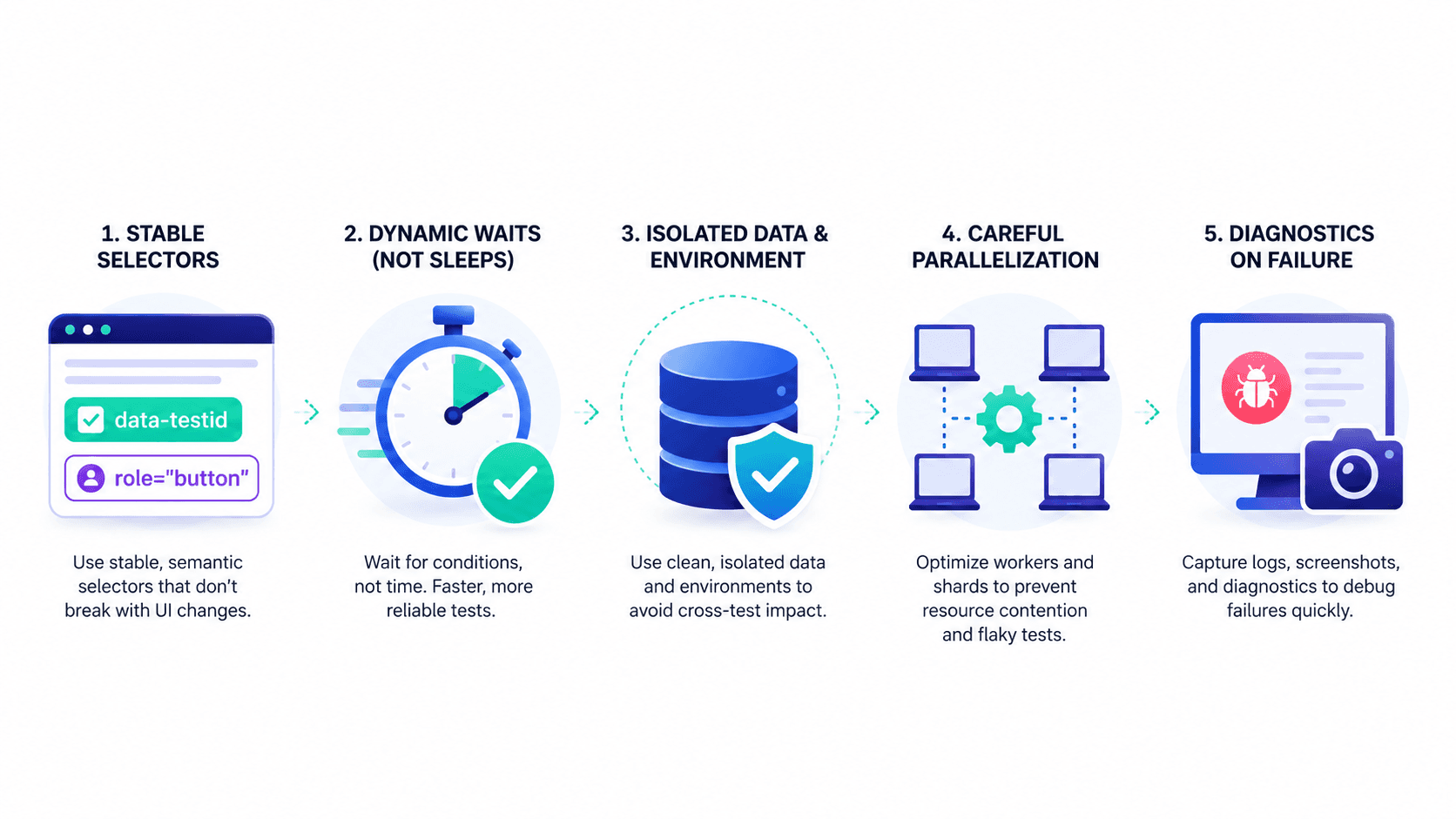
Once the suite is appropriately scoped to critical journeys, the next discipline is building each test to be reliable rather than brittle. The techniques that achieve this directly address the root causes of flakiness.
Use stable selectors. Prefer semantic identifiers like data-testid and ARIA-role locators over CSS classes, pixel coordinates, or DOM hierarchies. Stable selectors outlive the layout and styling changes that break fragile ones, eliminating the largest source of brittleness from UI changes.
Use dynamic waits, not fixed sleeps. Replace fixed sleep commands with dynamic waits that pause only until the element appears, the data loads, or the operation completes. This addresses the asynchronous wait issues that cause 45 percent of flaky tests, making tests both more reliable and faster because they wait exactly as long as needed and no longer.
Isolate test data and environment. Run tests in clean, isolated environments where each test sets up its own data and does not depend on or contaminate the state of other tests. Environment isolation prevents the cross-contamination that makes tests fail based on what ran before them rather than on the code being tested.
Manage parallelization carefully. Running tests in parallel across containers or shards introduces timing and state-sharing issues that do not occur in sequential runs. Research found that 46.5 percent of flaky tests are resource-affected, passing or failing based on machine resources rather than code. Profiling memory before adding parallel workers, and settling on a sensible shard and worker count, prevents the resource contention that creates this category of flakiness.
Capture diagnostics on failure. When a test fails in CI, ensure logs, screenshots, and other diagnostics are captured to make debugging fast. E2E failures are inherently harder to debug than lower-layer failures because they span the whole system, so good diagnostics are what keep the debugging time manageable.
The modern tooling has caught up to what these practices require. Playwright crossed 33 million weekly downloads in early 2026 with a 91 percent satisfaction rating, reflecting how much more reliable browser automation has become. But the tooling is not the differentiator. Most flaky, unloved E2E suites are running modern tooling badly rather than legacy tooling well. The difference between a reliable suite and a brittle one is the discipline around selectors, test data, waiting, and parallelization, not the framework choice.
Testing E2E in Microservices and Distributed Systems
End-to-end testing in microservices architectures is where the brittleness risk is highest and the discipline matters most, because the distributed nature of the system multiplies every challenge.
In a microservices architecture, an E2E test must orchestrate multiple services: ensuring all required services spin up or are appropriately stubbed, configuring them with the right endpoints and data, and coordinating calls between them. Every external integration, whether a third-party API or a legacy system, needs to be either included or simulated. This orchestration complexity is why heavy reliance on E2E testing in microservices can create a distributed monolith that slows deployments and undermines the agility microservices are supposed to provide.
The balanced approach that works in 2026 combines strong unit and contract tests with a lean set of high-value E2E tests. Contract testing deserves particular emphasis in microservices: rather than testing every service interaction through full E2E flows, contract tests verify that each service meets the interface expectations the other services depend on. This catches the integration failures that matter, the ones where a change to one service breaks the services that call it, without requiring the full system to run for every test. The cascading failure where one change to a shared authentication service breaks dozens of unrelated tests is exactly what contract testing prevents.
The environment challenge has modern solutions. Ephemeral preview environments that spin up a full stack per pull request let teams test complex workflows in isolation before merging, dramatically reducing the integration issues that surface later. Rather than maintaining a perpetually almost-like-production shared staging environment with all its configuration drift, per-PR environments give each change a clean, complete environment to test against.
This is where Cloud and Modernization Testing connects directly, because the distributed, cloud-native systems that microservices produce are exactly the systems that require this testing discipline. Validating that a distributed system works correctly across its services, under realistic conditions, in environments that mirror production, is the testing challenge that modern cloud architectures present, and it requires the orchestration, contract testing, and environment management that distinguish reliable distributed-system testing from brittle attempts to test everything through the UI.
Treating Flaky Tests as Bugs, Not Noise
The single behavior that most distinguishes teams with reliable E2E suites from teams with brittle ones is how they respond to a flaky test. The disciplined teams treat flaky tests as bugs. When a test flakes, it gets fixed or deleted, never ignored.
This matters because of what flaky tests do to team behavior. The most damaging part of flaky tests is not the time lost during investigation. It is the behavior they create. Once developers learn that some failures are just noise, they start rerunning instead of investigating. Over time, teams begin shipping despite red builds, and test failures get ignored during code review. A green build that lies, or a red build everyone ignores, defeats the entire purpose of having an automated suite.
The economics justify treating flakiness seriously. Flaky tests cost a 20-engineer team roughly $120,000 per year in wasted CI minutes and engineer-hours, and the mean time to fix a single flaky test is 3.7 engineering hours. The cost is real, but the cost of not fixing them, an entire suite the team has learned to ignore, is far higher because it eliminates the protection the suite was supposed to provide.
A flaky test policy operationalizes the discipline. The policy defines what happens when a test flakes: a quarantine threshold such as three intermittent failures, an ownership assignment so a specific person investigates within a defined time, and a resolution requirement that the test is fixed or deleted within a defined window rather than left to flake indefinitely. This converts flakiness from an accumulating erosion of trust into a managed process that keeps the suite reliable.
The flaky test policy connects to the broader governance that keeps an E2E suite healthy: every major flow has an owner who reviews its design and dependencies, test architecture reviews happen periodically to retire obsolete flows, and central dashboards show test stability and failure trends. This governance is what keeps the suite lean, relevant, and trusted over time rather than decaying into technical debt.
How AI Is Changing E2E Test Reliability
The most significant shift in end-to-end testing is the application of AI to the reliability problem, specifically through self-healing tests that adapt to application changes automatically.
Self-healing addresses the brittleness that comes from UI changes. When a selector changes, a traditional test breaks and requires manual repair. A self-healing test recognizes the changed element and updates its selector automatically, eliminating the manual maintenance that consumes so much QA time. AI-powered platforms report up to 80 percent reduction in test flakiness across production deployments through this approach, using neural networks trained on large datasets of UI patterns to identify elements more reliably than rule-based selectors.
AI is also being applied to flaky test repair directly. Research demonstrated that AI can repair 47.6 percent of reproducible flaky tests, with more than half of the fixes accepted by developers. While this is early-stage, it points toward a future where the flaky test maintenance burden is substantially handled by AI rather than consuming 40 percent of QA team time.
The strategic implication is that the economics of E2E testing are shifting. The historical trade-off, that E2E tests are valuable but expensive to maintain, is being changed by AI that reduces the maintenance cost. This does not eliminate the need for the design discipline covered in this article. Self-healing applied to a bloated suite of UI tests that should have been API tests still produces a slow suite. But self-healing applied to a well-designed, appropriately-scoped suite of critical-journey tests makes that suite even more reliable and cheaper to maintain.
P99Soft's End-to-End System Testing practice incorporates these AI capabilities where they add value, using self-healing to reduce maintenance on the critical-journey suite, while maintaining the design discipline, appropriate scoping, stable selectors, isolated data, and proper governance, that no amount of AI can substitute for. The combination of disciplined design and AI-assisted maintenance produces E2E suites that are both reliable and affordable to maintain, turning end-to-end testing from a necessary evil into a competitive advantage. The connection to Automated and Performance Testing completes the picture, integrating the reliable E2E suite into the broader continuous testing pipeline where it runs on every change as a trusted gate rather than a flaky bottleneck.
FAQ
What is end-to-end system testing?
End-to-end system testing validates that an application works correctly from the user's perspective, exercising the entire application stack from the user interface through the backend services and databases and back. Unlike unit tests that verify isolated functions or integration tests that check communication between two components, E2E tests validate complete user journeys, such as logging in, selecting a product, checking out, and receiving confirmation, with every service that participates working together correctly. Its unique value is catching failures that only appear when the whole system operates together, which lower-layer tests cannot detect because those failures live in the interactions between components rather than within any single component.
Why are end-to-end tests so brittle and flaky?
E2E tests become brittle due to specific design mistakes, not because the technique is inherently unreliable. The main causes are testing too much through the UI rather than scoping to critical journeys, using fragile selectors like CSS classes that break when layouts change, sharing test data between tests so they contaminate each other, using fixed sleep commands instead of dynamic waits which causes the timing issues responsible for roughly 45 percent of flakiness, and having no clear ownership so brittle tests accumulate. Industry data shows 15 to 25 percent of E2E tests exhibit flaky behavior. The fix is design discipline: scope to critical journeys, use stable selectors, isolate test data and environments, use dynamic waits, and assign ownership.
How many end-to-end tests should you have?
End-to-end tests should be the smallest layer of the test pyramid, typically 5 to 10 percent of total test count, covering only the critical user journeys the business cannot ship without. For most products, this lands between 20 and 200 E2E tests. The reason for keeping the number small is that E2E tests are slow, fragile, and expensive to maintain compared to unit and integration tests. A focused E2E suite backed by a strong foundation of fast unit and integration tests catches more defects more reliably than a bloated E2E suite attempting exhaustive coverage. Organizations using a well-structured pyramid reduce test suite run times by up to 80 percent while catching more defects earlier.
How do you make end-to-end tests more reliable?
Reliability comes from addressing the root causes of flakiness through design. Use stable, semantic selectors like data-testid and ARIA-role locators that survive UI changes rather than fragile CSS classes or coordinates. Replace fixed sleep commands with dynamic waits that pause only until operations complete, addressing the timing issues that cause most flakiness. Isolate test data and environments so tests do not contaminate each other. Manage parallelization carefully to avoid the resource contention that causes nearly half of flaky tests. Capture diagnostics on failure for fast debugging. Finally, treat every flaky test as a bug to fix or delete rather than noise to rerun, supported by a flaky test policy with quarantine thresholds, ownership, and resolution timelines that keep the suite trusted.
Author Name - Mrunalini Wankhede