Data Migration to the Cloud: How to Move Years of Enterprise Data Without Losing Integrity, History, or Trust
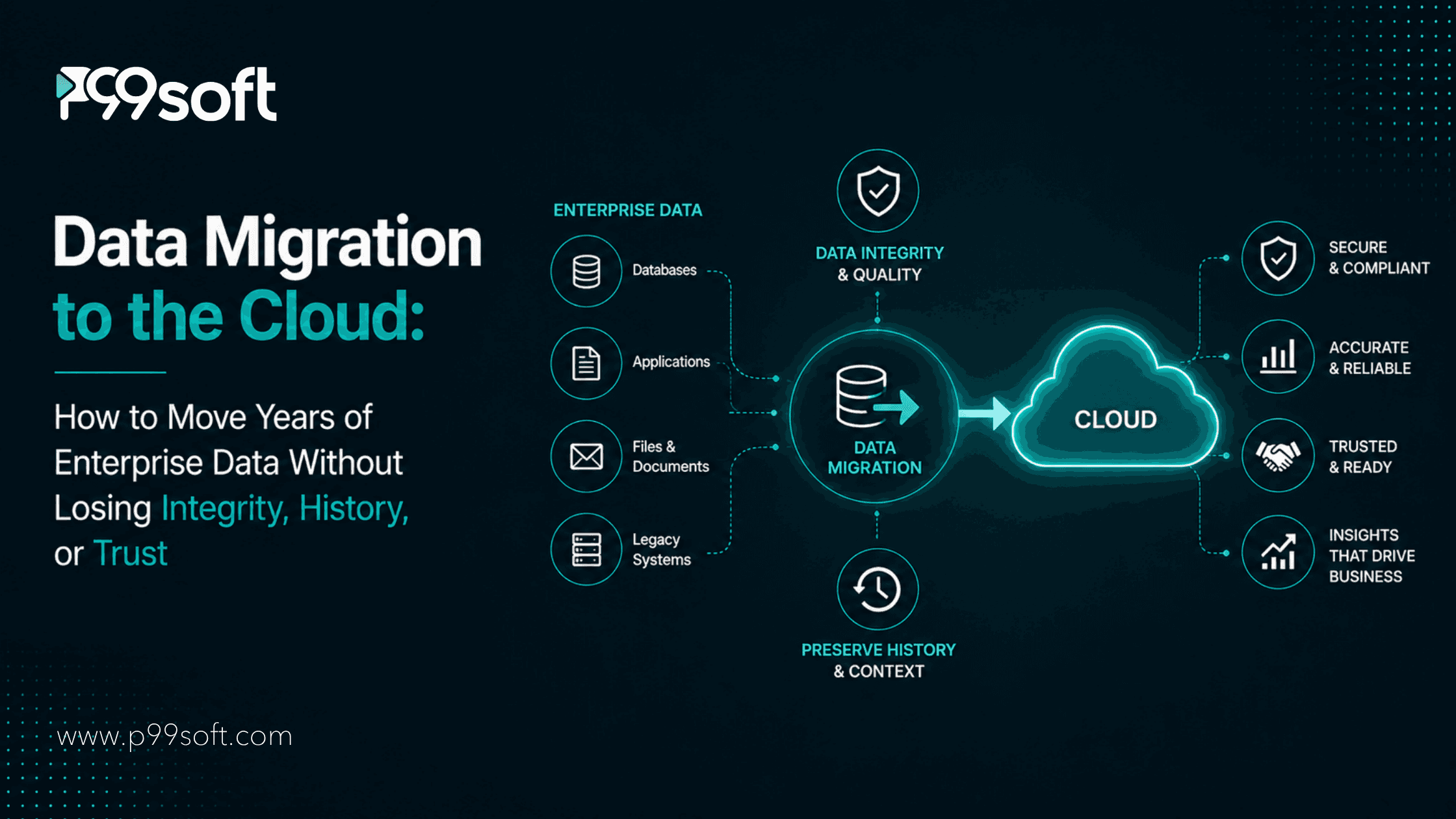
Enterprise data migration to the cloud requires five disciplines executed in sequence: a complete data inventory and quality audit before any movement begins, explicit schema mapping between source and target systems, continuous replication that keeps the target current rather than one-time bulk transfer, field-level validation that confirms integrity rather than assuming it from row counts, and a cutover sequence that quiesces writes before switching to prevent transaction loss. Organizations that conduct a formal readiness assessment before migrating have 2.4 times higher success rates.
Infrastructure migration has a rollback. Data migration does not.
A migrated application that misbehaves can be redirected back to the legacy environment in minutes. Migrated data that was corrupted, truncated, or silently altered during transfer may not reveal the damage for weeks, by which point the legacy system has been decommissioned, new data has been written on top of the corrupted foundation, and the recovery requires manual reconciliation across thousands or millions of records.
This asymmetry is why data migration deserves its own strategy, its own program structure, and its own validation discipline rather than being treated as a step inside a broader infrastructure migration.
The numbers explain the caution. 18% of organizations experienced failed data transfers during migration leading to data integrity problems. Oracle highlights that 70% of enterprises underestimate their cloud-data footprint due to unmanaged assets. And manual errors cause 83% of migration failures, which is why tooling and automation matter as much as planning.
The encouraging number sits alongside the cautionary ones: organizations that conduct a formal readiness assessment before migrating have 2.4 times higher success rates. Data migration outcomes are not random. They are determined by the work done before the first byte moves.
In 2025, global data creation surpassed 180 zettabytes, up nearly 150 percent from just a few years ago. The data estates being migrated in 2026 are larger, older, and more interconnected than the estates that earlier migration playbooks were written for. This guide covers what the discipline looks like at that scale.
Why Data Migration Fails More Often Than Infrastructure Migration
Data migration has failure modes that infrastructure migration does not, and understanding them before planning begins is what separates programs that protect data integrity from programs that discover integrity problems in production.
The data footprint is larger than anyone documented. 70% of enterprises underestimate their cloud-data footprint due to unmanaged assets. Years of operation produce data in places the official architecture diagrams never captured: spreadsheet exports that became systems of record, database copies made for a reporting project that teams still query, file shares holding documents that a compliance process depends on, and shadow databases created by departments that needed something IT could not deliver fast enough. A migration scoped against the documented data estate moves the documented data and strands everything else.
Data quality problems are invisible until they move. A legacy database that has operated for a decade contains data quality issues that the legacy application tolerates: date fields holding text, character encoding inconsistencies from system changes years ago, orphaned records whose parent records were deleted, and duplicate entries that users learned to work around. The legacy application was built around these quirks. The target cloud system was not. Data that functioned in the source system fails validation, breaks constraints, or silently transforms during migration to the target.
Transformation errors are silent. When data moves between systems with different schemas, every field passes through a mapping and transformation layer. A mapping error that truncates a field, misinterprets a date format, or drops a decimal place does not produce an error message. It produces data that looks plausible and is wrong. Missing, incomplete, or altered data during transfer represents one of the most critical threats in any migration project. Data can be lost due to network interruptions, incompatible formats, or transformation errors during the ETL process.
The cutover window has a transaction gap risk. Between the moment the last replication completes and the moment writes switch to the new system, any transaction written to the legacy system exists only there. If the cutover proceeds without accounting for this gap, those transactions are lost permanently and invisibly.
Data migration failure is rarely a single catastrophic event. It is an accumulation of small integrity losses, an undiscovered data source here, a silent transformation error there, a transaction gap at cutover, that surface weeks later as report discrepancies, customer complaints, and the slow erosion of trust in the migrated system.
Step 1: The Data Inventory and Quality Audit That Defines the Real Scope
The first deliverable of any enterprise data migration is a complete inventory of what data exists, where it lives, who owns it, and what condition it is in. Not the inventory in the architecture documentation. The inventory produced by actually discovering what is running and what is being used.
The discovery process combines automated scanning of the infrastructure estate with structured interviews across departments. The automated scan finds the databases, file shares, and storage systems that exist. The interviews find out which of them matter: which spreadsheet on which file share is actually the pricing master that three teams depend on, which database copy is actively queried versus genuinely abandoned, and which data has retention requirements that the migration must preserve.
For each data source in the inventory, the audit documents four attributes. Volume: how much data, growing at what rate. Ownership: which team is accountable for its accuracy and can validate it after migration. Sensitivity: what regulatory and privacy classifications apply, which determines encryption, residency, and access control requirements in the target environment. And quality: the actual condition of the data, measured rather than assumed.
The quality measurement is the component most frequently skipped and most expensive to skip. A data profiling exercise that runs against each source before migration quantifies the issues that will otherwise surface during transfer: null rates in fields the target schema requires, format inconsistencies in dates and identifiers, duplicate rates, referential integrity violations, and encoding anomalies. Every issue found in profiling is an issue resolved on a planned timeline. Every issue found during migration is an incident.
The output of this phase is the honest scope: what moves, what gets cleansed before moving, what gets archived rather than migrated, and what gets retired entirely. Years of accumulated data always includes a meaningful percentage that no business process has touched in years. Migrating it costs money and adds risk. Archiving it to low-cost cloud storage with a documented retrieval path satisfies retention requirements without carrying dead weight through the migration pipeline.
P99Soft's Cloud and Data Migration practice begins every data migration engagement with this inventory and profiling phase, because the scope it produces is the foundation every subsequent estimate, timeline, and architecture decision rests on.
Step 2: Schema Mapping and the Transformation Design
Once the scope is honest, the next discipline is explicit schema mapping: a documented specification of how every field in every source system corresponds to the target system, including the transformations applied in between.
The mapping exercise surfaces the structural decisions that determine whether the migrated data serves the business or merely resembles the source. Source systems built over years contain fields whose meaning drifted: a status column that meant one thing in 2018 and another after a process change in 2022, a notes field that teams used to store structured data the original schema never accommodated, and identifier formats that changed when the company merged or rebranded. The mapping process forces these histories into the open, where decisions can be made deliberately rather than discovered as anomalies after migration.
Three categories of mapping decision require business input rather than purely technical judgment.
Historical data interpretation. When the meaning of a field changed over time, the mapping must decide whether to normalize historical records to the current meaning, preserve them as-is with documentation, or split them into separate fields. The right answer depends on how the business uses historical data, which is a question for the data owners identified in the inventory, not for the migration engineers.
Precision and format standardization. Currency fields with inconsistent decimal handling, timestamps stored in mixed time zones, and addresses in free-text fields all require standardization rules. The rules are easy to write and consequential to get wrong: a time zone normalization error applied across years of transaction timestamps quietly shifts every historical report.
Data that has no home in the target schema. Every legacy system contains data the new system was not designed to hold. The mapping must explicitly decide its fate: extend the target schema, store it in a designated archive structure, or document its retirement. Undecided data is data that disappears silently.
The mapping document becomes the contract for the migration. Validation in later phases tests against it. Disputes about whether migrated data is correct resolve against it. Its completeness is the single best predictor of how smoothly the execution phases run.
Step 3: Continuous Replication Instead of Big-Bang Transfer
The transfer architecture decision, how data physically moves from source to target, determines both the risk profile of the cutover and the length of the window during which the business operates with elevated risk.
The big-bang approach, where the source system is frozen, all data is exported, transferred, and imported, and the business resumes on the target, has one virtue: simplicity. It also has a fatal flaw at enterprise scale: the freeze window. Transferring years of enterprise data takes hours to days. A business that cannot freeze its operations for that window cannot use this approach for its operational systems, and most cannot.
Continuous replication is the architecture that removes the freeze window. An initial bulk load moves the historical data while the source system continues operating. Change data capture then streams every subsequent insert, update, and delete from the source to the target in near real time. The target stays within seconds of the source for as long as the replication runs, which can be days or weeks while validation proceeds.
This architecture transforms the cutover from a high-stakes event into a controlled procedure. Because the target is continuously current, the cutover requires only a brief write-quiesce on the source, a final synchronization check confirming the replication lag is zero, and the switch of write traffic to the target. The window of elevated risk shrinks from days to minutes.
Continuous replication also enables the most valuable validation pattern available: running the legacy and cloud systems in parallel against the same live data. Reports generated from both systems can be compared daily. Application behavior against the migrated data can be tested under real load patterns. Discrepancies surface while the legacy system is still authoritative and the cost of correction is an investigation rather than an incident.
47% of organizations experienced at least one major outage after moving applications to cloud environments, and more than 60% of enterprise cloud incidents stem from customer misconfigurations and poor migration governance rather than provider failures. The parallel validation period is the governance mechanism that catches those misconfigurations before they become the outage statistic.
Step 4: Validation That Confirms Integrity Instead of Assuming It
The validation discipline is where data migrations earn the trust the migrated system will need. Row counts that match between source and target are the beginning of validation, not the end of it. A target table can hold the correct number of rows where every date has been shifted by a time zone error.
Enterprise-grade validation operates at four levels, each catching a class of error the previous level cannot.
Reconciliation totals. Row counts per table, sum totals on every numeric column that carries business meaning, and distinct counts on key identifiers. These catch wholesale loss, duplication, and truncation. Implementing checksum validation and automated reconciliation reports verifies data integrity at every stage of the transfer rather than only at the end.
Field-level sampling. Statistically meaningful samples of records compared field by field between source and target, including the fields that passed through transformations. This is where mapping errors surface: the truncated text field, the misparsed date, the dropped decimal. Sampling should be weighted toward the record types the profiling phase flagged as highest-risk rather than drawn uniformly.
Query equivalence testing. The most important reports, dashboards, and application queries executed against both systems with results compared. This validates not just that the data arrived but that it behaves identically under the access patterns the business actually uses. A migration can pass field-level validation and still fail query equivalence when indexing differences or collation changes alter how queries match records.
Business acceptance validation. The data owners identified in the inventory phase reviewing their own data in the target system and confirming it is correct. This step is partly technical and substantially organizational: the owner who validates the data before cutover is the owner who trusts it after cutover. Trust in migrated data is built before go-live or rebuilt expensively after it.
This validation discipline is the same principle that determines CRM data migration outcomes, where moving dirty data into a clean system produces a system users abandon. Our article on CRM Implementation Failure: The 7 Reasons Enterprise Salesforce Projects Miss Their Business Case covers how the data quality failure mode plays out specifically in Salesforce implementations, where the data migration is frequently the difference between a CRM users trust and one they quietly work around. For organizations migrating CRM data as part of a broader cloud program, the CRM Implementation and Customization practice applies this same validation framework to the customer data layer specifically.
Step 5: The Cutover Sequence That Prevents Transaction Loss
The cutover is the moment of highest risk in any data migration: the transition of write authority from the legacy system to the cloud system. The sequence that executes it safely has five steps, each with an explicit confirmation before the next proceeds.
Quiesce writes on the source. Application write traffic is paused or routed to a queue. The duration of this pause, with continuous replication in place, is minutes.
Confirm replication completion. The replication lag is verified at zero. Every transaction written to the source exists on the target. This confirmation closes the transaction gap that loses data in cutover sequences that skip it.
Run the final reconciliation. The reconciliation totals from the validation framework execute one final time against both systems. Matching totals are the go signal. Any discrepancy halts the cutover with the legacy system still authoritative and nothing lost.
Switch write traffic to the target. Applications begin writing to the cloud system. Read traffic follows immediately or in stages depending on the architecture.
Hold the rollback window open. The legacy system remains intact and the reverse replication path, streaming changes from the new system back to the legacy system, runs for a defined period. If a critical issue emerges in the first days of cloud operation, the business can return to the legacy system without losing the transactions written to the cloud system in the interim. The rollback window typically holds for two to four weeks before the legacy system is formally retired.
The discipline of holding the rollback window open is what separates organizations that decommission with confidence from those that decommission on schedule and regret it. 38% of migrations exceed their original budget with an average overrun of 23%, and a meaningful share of those overruns are recovery costs from cutover problems that a rollback window would have contained.
The Data Layer After Migration: Governance and the Analytics Opportunity
The completed migration is not the end of the data program. It is the moment two new workstreams begin, and organizations that plan for both capture significantly more value from the migration investment.
Governance that prevents quality regression. The data quality achieved through the cleansing and validation effort degrades without active governance. The cloud environment needs the data quality rules from the migration codified as ongoing controls: validation at the point of entry, scheduled profiling that detects drift, and ownership assignments that survived the migration program's closure. 80% of data governance initiatives are predicted to fail by 2027 without proper management, and the most common failure pattern is governance treated as a migration deliverable rather than an operating discipline. The Managed Support Services engagement model carries this governance forward after the migration program closes, maintaining the data quality standard the migration established.
The analytics capability the migration unlocked. Years of enterprise data, newly consolidated, cleansed, and resting on cloud infrastructure, is the foundation that analytics programs have usually been waiting for. The historical data that lived in fragmented legacy systems can now answer questions it never could: trend analysis across the full history, customer behavior patterns across previously disconnected systems, and the predictive models that require exactly the clean, unified data layer the migration produced. The Analytics and Insights practice connects at this point, building the BI foundation and analytics layer on top of the migrated data estate while the data quality is at its peak.
For organizations at the start of this journey rather than the end, the Advisory and Consulting practice structures the migration strategy before execution begins: the inventory approach, the workload and data sequencing, the architecture decisions between bulk transfer and continuous replication, and the financial model that gives the program a validated business case before the first byte moves.
FAQ
What is the biggest risk in enterprise data migration to the cloud?
The biggest risk is silent data integrity loss: data that was corrupted, truncated, or incorrectly transformed during migration but looks plausible enough that the damage is not discovered until weeks after cutover. 18% of organizations experience failed data transfers leading to integrity problems. Unlike application migration, data migration has no simple rollback once the legacy system is decommissioned and new data has been written on top of the corrupted foundation. The prevention is a four-level validation framework covering reconciliation totals, field-level sampling, query equivalence testing, and business owner acceptance, executed before cutover rather than after problems surface.
How do you migrate enterprise data to the cloud without downtime?
The continuous replication architecture eliminates the extended freeze window that bulk transfer approaches require. An initial bulk load moves historical data while the source system continues operating normally, then change data capture streams every subsequent transaction to the cloud target in near real time. The target stays within seconds of the source for as long as needed for validation. The final cutover requires only a brief write pause of minutes, a confirmation that replication lag is zero, and the switch of write traffic to the cloud system. This approach also enables parallel running, where both systems operate against the same live data while validation completes.
How long does an enterprise cloud data migration take?
Timeline depends on data volume, the number of source systems, data quality condition, and validation requirements, but enterprise data migrations typically run three to nine months from inventory to decommissioning. The inventory and profiling phase takes four to eight weeks. Schema mapping and transformation design takes four to six weeks. The replication setup, parallel running, and validation period takes six to twelve weeks. The cutover itself takes hours, followed by a two to four week rollback window before the legacy system is retired. Programs that compress the validation and parallel running phases to hit a date are the programs that appear in the 38% of migrations that exceed budget, because post-cutover remediation costs more than pre-cutover validation.
What should you do with legacy data that the new cloud system does not need?
The data inventory phase should explicitly classify data into four categories: migrate, cleanse then migrate, archive, and retire. Data that no business process has accessed in years but that retention requirements cover belongs in low-cost cloud archive storage with a documented retrieval path, not in the active migration pipeline. Data with no retention requirement and no business use should be formally retired with sign-off from its owner. Migrating everything indiscriminately increases cost, extends timeline, and carries legacy data quality problems into the new environment. Organizations consistently find that a meaningful percentage of their data estate belongs in the archive and retire categories once ownership and usage are honestly assessed.
Author Name - Mrunalini Wankhede