What Is Robotic Process Automation? How RPA Actually Works and Where It Delivers Real ROI in 2026
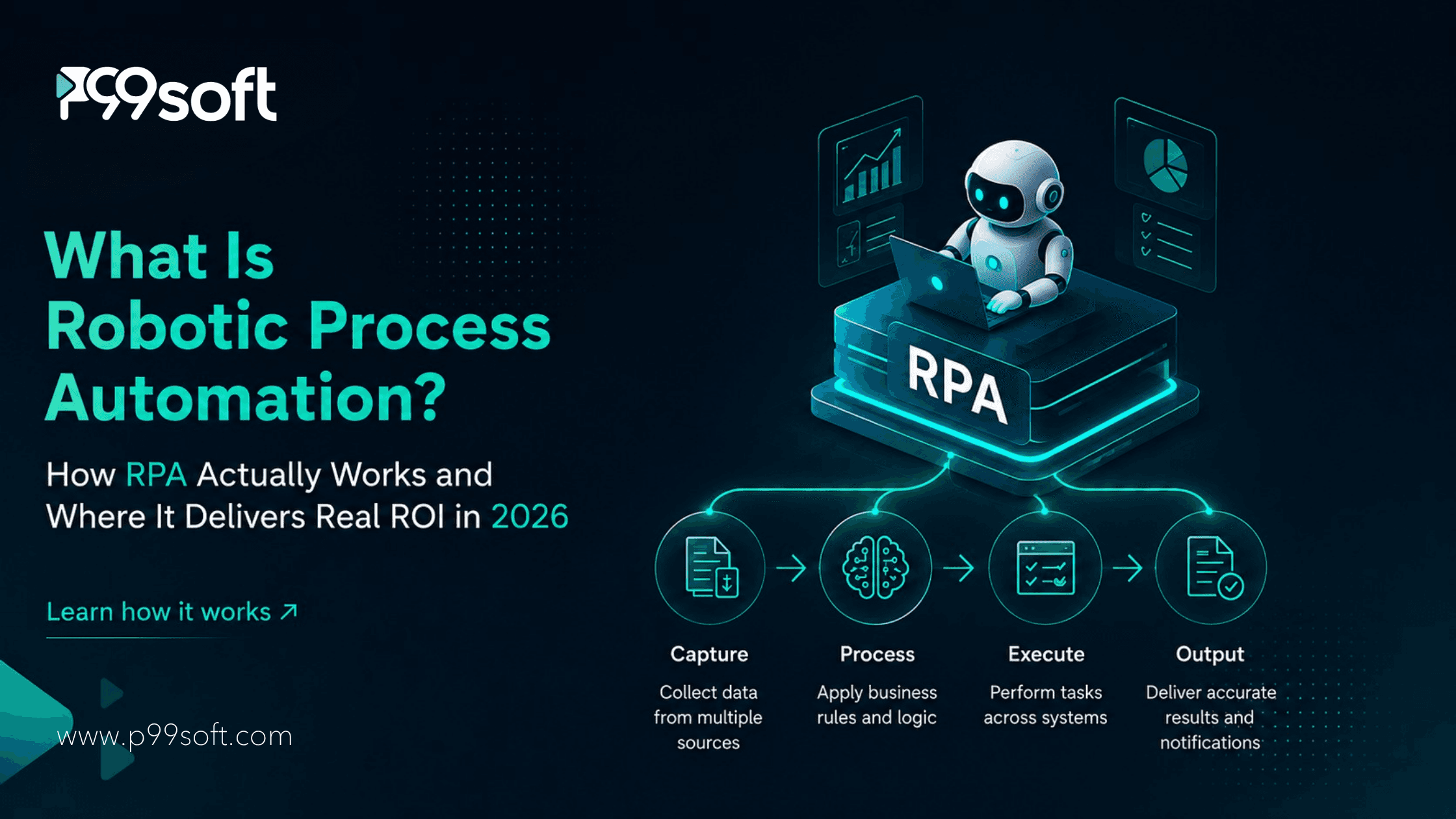
Robotic Process Automation (RPA) is software that performs repetitive, rule-based digital tasks the way a human would, by interacting with applications through their user interfaces or APIs. It logs into systems, copies and moves data, fills in forms, and follows defined rules, without human intervention. RPA delivers real ROI on high-volume, stable, rule-based processes, where it reduces operational costs by 30 to 80 percent and returns 200 to 300 percent within the first year. It fails on processes that change frequently or require human judgment.
Robotic Process Automation has a reputation problem that is the opposite of most enterprise technology. Most technology is overhyped and underdelivers. RPA delivered real, measurable value to early adopters, then accumulated a reputation for failed implementations not because the technology stopped working but because organizations applied it to the wrong processes.
Understanding what RPA actually is, how it actually works, and specifically where it delivers real ROI versus where it produces expensive disappointment is the difference between an automation program that returns 200 to 300 percent in the first year and one that produces a collection of broken bots nobody maintains.
The numbers for well-applied RPA are genuinely strong. Average RPA ROI is 200 to 300 percent within the first year according to Gartner. Most organizations recoup their RPA investment in 6 to 9 months. For repetitive processes, automation reduces operational costs between 30 and 80 percent compared to manual processes. RPA increases accuracy to 99.5 percent, reducing rework by 60 percent.
The market reflects this value. The global RPA market is projected to reach $8.33 billion in 2026, growing toward $13.39 billion by 2030. By 2026, more than 75 percent of large enterprises worldwide will have adopted RPA.
But every one of those ROI figures comes with an unstated condition: the RPA was applied to the right process. This article covers what RPA is, how it works, and the specific characteristics that separate the processes where RPA delivers those returns from the processes where it does not.
What RPA Actually Is
Robotic Process Automation is software that performs repetitive, rule-based digital tasks by mimicking the actions a human would take when using a computer. A software bot logs into applications, navigates screens, reads and enters data, copies information between systems, fills in forms, and follows predefined rules, all without human intervention.
The "robotic" in the name is misleading because it suggests physical robots. RPA bots are entirely software. They have no physical presence. A bot is a configured set of instructions that operates software applications the same way a human operator would, by interacting with the user interface, clicking buttons, reading fields, and entering data.
The defining characteristic of RPA is that it works through the existing interfaces of existing applications rather than through deep system integration. A traditional system integration connects two applications through their underlying databases or APIs, which requires development work on both systems. RPA connects to an application the way a human does, through the screen, which means it can automate interactions with applications that have no API and that cannot be modified.
This is RPA's primary strength and its primary weakness simultaneously. The strength is that RPA can automate processes involving legacy applications, third-party systems, and software that cannot be changed, because it does not require changing them. The weakness is that automation built on user interfaces is vulnerable to breaking when those interfaces change, which is the source of the maintenance burden that determines whether an RPA program is sustainable.
By operation, the rule-based segment accounts for the largest share of the RPA market, and by deployment, the cloud segment leads. This reflects what RPA is fundamentally good at: structured, rule-based, repeatable tasks, increasingly delivered through cloud-native platforms.
RPA is software that operates other software through its user interface, following defined rules, the way a human operator would. It excels at structured, repetitive, rule-based tasks and is fundamentally limited to them. Understanding that boundary is the key to applying RPA where it delivers value.
How RPA Actually Works
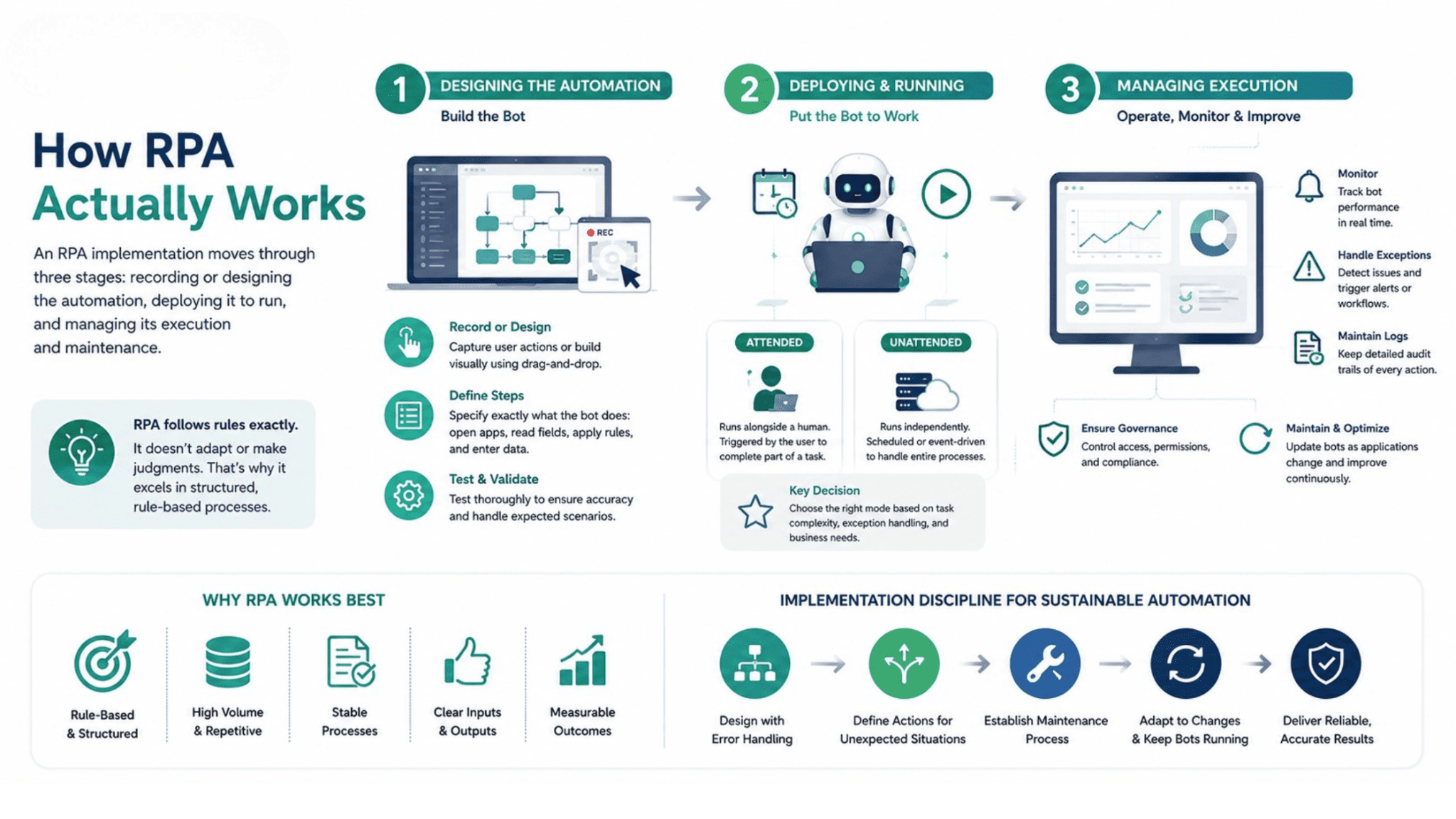
An RPA implementation moves through three stages: recording or designing the automation, deploying it to run, and managing its execution and maintenance.
Designing the automation. A developer or trained business analyst builds the automation by defining the sequence of steps the bot will perform. On accessible platforms, this can be done partly through recording, where the tool captures the actions a human takes and converts them to automation steps, and partly through a visual designer where the steps are assembled using drag-and-drop components. The automation specifies exactly what the bot does: which application to open, which fields to read, what rules to apply to the data, and where to enter the results.
Deploying and running. Once built and tested, the automation is deployed to run either attended or unattended. Attended automation runs alongside a human worker, triggered by the worker to handle part of a task while the human handles the rest. Unattended automation runs independently, often on a schedule or triggered by an event, handling the entire process without human involvement. The choice between attended and unattended automation is one of the most important RPA implementation decisions, and the consensus among mature programs is forming around clear criteria for when each is appropriate.
Managing execution. Running bots are managed through an orchestration layer that schedules their execution, monitors their performance, handles errors when they occur, and maintains the logs that show what each bot did. This management layer is where governance lives: the control over which bots run, what they can access, and the audit trail of their actions.
The mechanics matter for understanding where RPA works. A bot follows the rules it was given exactly. It does not adapt, interpret, or exercise judgment. When it encounters a situation its rules do not cover, it fails rather than improvising. This is precisely why RPA delivers reliable, accurate results on processes where every situation can be defined by a rule, and precisely why it fails on processes where situations arise that no rule anticipated.
The RPA implementation discipline that produces sustainable automation accounts for this from the design stage: building bots with proper error handling, defining what happens when the bot encounters an unexpected situation, and establishing the maintenance process that keeps bots running when the applications they automate change.
Where RPA Delivers Real ROI: The Process Characteristics That Matter
The processes where RPA delivers the 200 to 300 percent ROI figures share specific characteristics. Matching RPA to processes with these characteristics is the single most important factor in automation success.
High volume. RPA's value comes from performing a task many times. A process performed thousands of times per month produces far more value when automated than a process performed a few times. The bot's development and maintenance cost is fixed, so the return scales with the volume of executions. High-volume processes are where the economics of RPA are most favorable.
Rule-based with no judgment required. Every decision in the process can be expressed as a rule. "If the invoice amount matches the purchase order, approve it; if it does not, route it for review" is a rule. "Assess whether this customer complaint requires escalation" is a judgment. RPA handles the first perfectly and cannot handle the second. Processes where every decision is a rule rather than a judgment are RPA's ideal territory.
Stable and standardized. The process and the applications it uses do not change frequently. A bot built for a stable process keeps working. A bot built for a process that changes every quarter requires reworking every quarter, and the maintenance cost erodes the ROI. Stability is what makes automation durable.
Structured data. The data the process works with is structured and predictable. A bot can reliably read a specific field in a specific format. It struggles with unstructured data like free-text emails or scanned documents with variable layouts, unless paired with AI capabilities designed for that.
The processes that meet all four criteria, high volume, rule-based, stable, and structured, are where RPA produces its strongest returns. Invoice processing, data entry between systems, report generation, employee onboarding workflows, payroll processing, and claims processing in insurance are classic examples. Blue Prism reports 50 percent faster invoice processing yielding 35 percent savings. McKinsey reports RPA boosts productivity by 40 percent in finance operations.
This is exactly why Process Mining belongs before RPA implementation. Process mining uses event log data from existing systems to discover which processes have these characteristics, how often they run, and where the highest-value automation opportunities are. Selecting automation candidates through process mining rather than through intuition is the difference between automating the processes that deliver ROI and automating the processes that seemed like good candidates but did not have the volume or stability to pay back.
Where RPA Fails: The Processes to Avoid
Understanding where RPA fails is as valuable as understanding where it succeeds, because most failed RPA programs failed by applying RPA to processes with the wrong characteristics.
Processes that change frequently. A bot is built for a specific process and a specific set of application interfaces. When the process changes or the application updates its interface, the bot breaks. A process that changes every few months generates a continuous stream of bot maintenance work. The automation that was supposed to free up capacity instead consumes it in maintenance. Processes undergoing active change, or applications being actively developed, are poor RPA candidates until they stabilize.
Processes requiring judgment. Any process where a human currently makes a decision that cannot be reduced to a rule is a process RPA cannot fully automate. RPA can handle the rule-based portions of such a process, but the judgment-based steps require either human involvement or AI capabilities beyond standard RPA.
Processes with highly variable, unstructured inputs. A process that receives information in many different formats, free-text emails, documents with variable layouts, handwritten forms, requires more than rule-based RPA. The bot cannot reliably extract data from inputs whose structure varies unpredictably. This is where the combination of RPA with AI document processing becomes necessary.
Broken processes. This is the most important failure mode and the most common. Automating a broken process does not fix it. It makes the dysfunction run faster and become harder to change. A process full of rework loops, manual workarounds, and undocumented exceptions, automated exactly as it is, encodes all of that dysfunction into a bot that is now load-bearing infrastructure nobody fully understands. The process should be fixed before it is automated, not automated in its broken state.
The discipline of fixing before automating connects to the Low-Code No-Code (LCNC) consideration. Sometimes the right answer to a broken process is not an RPA bot at all but a properly built application that handles the process correctly. RPA automates the interaction with existing applications. When the existing applications are the problem, building a better application through low-code development may produce a more durable result than automating the interaction with the broken one.
RPA Plus AI: How Intelligent Automation Extends the Boundary
The processes that pure rule-based RPA cannot handle, those involving unstructured data or judgment, are increasingly addressable through the combination of RPA and AI that defines intelligent automation in 2026.
The integration works by dividing the process between the two technologies. RPA handles the structured, rule-based steps it excels at. AI handles the steps that require interpreting unstructured data or making judgment-based decisions. A document processing workflow uses AI to extract data from a variable-format invoice, then RPA to enter that extracted data into the accounting system following defined rules. The AI handles the part RPA cannot, and RPA handles the part it does best.
The market growth in RPA is substantially driven by this AI integration. The market's growth can be attributed to the increased capabilities and features of RPA solutions enabled by AI integration, resulting in improved business results and higher ROI. AI capabilities embedded in cloud-based RPA are expected to dominate the market, allowing businesses to scale automation rapidly.
This extension of RPA's boundary through AI is what makes 2026 a different RPA landscape than the early RPA era. Processes that were genuinely beyond rule-based RPA, requiring document understanding, natural language processing, or pattern-based decision-making, are now automatable through the intelligent automation combination. The Chatbots integration extends this further: a process that begins with a natural language customer interaction can be handled end to end, with the chatbot managing the conversation, AI interpreting the intent, and RPA executing the structured backend processing.
For organizations evaluating which RPA platform supports this AI integration most effectively, the platform comparison matters. The UiPath platform integrates AI and document processing most broadly, while the Blue Prism platform offers the governance-first model for regulated environments where the AI integration must operate within strict controls.
Building a Sustainable RPA Program: Beyond the First Bots
The pattern that separates RPA programs delivering long-term ROI from programs that deliver a few successful bots and then stall is the presence of a governance and scaling structure.
Enterprises are increasingly focused on RPA implementation best practices to ensure sustainable success, moving beyond tactical deployments. A key component is scaling RPA with a center of excellence, which is essential for managing the program effectively as it grows.
The first few bots in an RPA program are usually successful. They were selected because they were obvious automation candidates, built carefully, and monitored closely. The challenge is scaling past those first successes to an automation portfolio that delivers value across the organization. This scaling is where most programs stall, for reasons that are organizational rather than technical.
A center of excellence addresses the scaling challenge by establishing the governance, standards, and reuse that make each new automation faster and more reliable than the last. It maintains the bot inventory and prevents the sprawl of undocumented bots. It establishes reusable components that accelerate new automation development. It runs the intake and prioritization process that ensures automation effort goes to the highest-value candidates. And it owns the maintenance process that keeps the bot portfolio running as the applications it depends on change.
The maintenance dimension deserves specific emphasis because it is the most underestimated cost in RPA. Every bot is vulnerable to breaking when its underlying applications change. A program with 50 bots and no systematic maintenance process accumulates broken bots faster than it can repair them. The QA and Testing discipline applied to RPA, validating bots against the full range of conditions they will encounter before deployment and re-testing them when applications change, is what keeps the bot portfolio reliable as it scales.
P99Soft's RPA practice builds this sustainability into the program from the start: the process mining that selects the right automation candidates, the platform selection matched to the organization's requirements, the governance model that controls the program as it scales, and the maintenance discipline that keeps the portfolio reliable. The goal is an automation program that delivers the 200 to 300 percent ROI on a durable basis rather than a collection of bots that work initially and degrade over time.
The Realistic RPA ROI Timeline
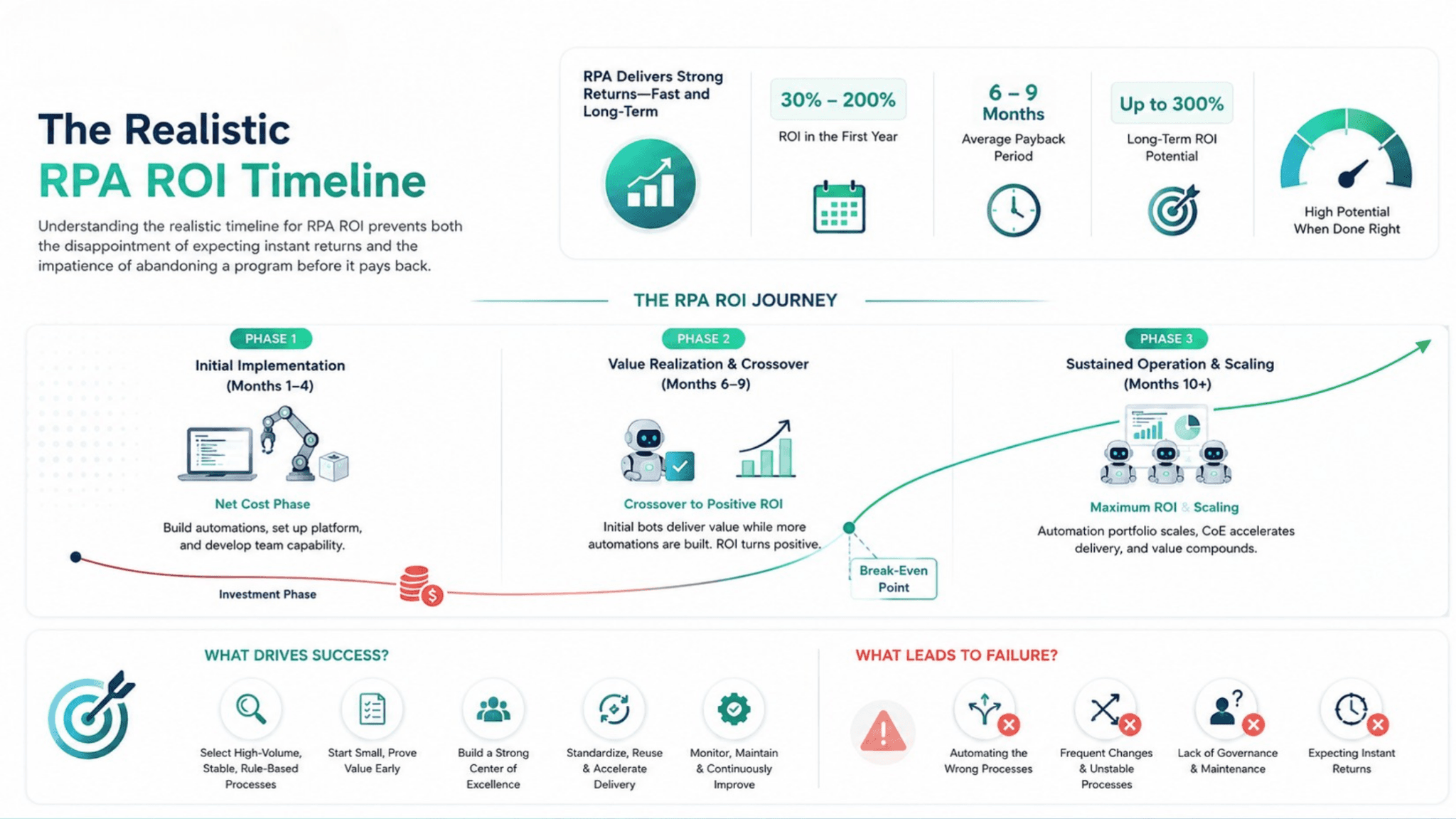
Understanding the realistic timeline for RPA ROI prevents both the disappointment of expecting instant returns and the impatience of abandoning a program before it pays back.
SMEs adopting cloud-based RPA can achieve ROI ranging from 30 percent to 200 percent within the first year of implementation. Most organizations recoup their investment in 6 to 9 months. The expected ROI from RPA adoption ranges from 30 to 200 percent in the first year, with potential long-term ROI of up to 300 percent.
The timeline breaks into phases. The first phase, the initial implementation, is a net cost: building the first automations, establishing the platform, and developing the team capability. This phase typically spans the first two to four months and produces the first few working bots without yet delivering net positive return.
The second phase, where the initial automations are running and delivering value while additional automations are being built, is where the crossover to positive ROI occurs, typically in months 6 to 9. The automations built in the first phase are now returning value continuously while the program's capability to build more automations is established.
The third phase, sustained operation and scaling, is where the program delivers its full ROI. The automation portfolio is running, the center of excellence is making each new automation faster to build, and the cumulative value of the portfolio compounds. This is where the 200 to 300 percent figures are realized, on a foundation of properly selected processes, well-built bots, and sustained maintenance.
The single most important factor in achieving this timeline is process selection. A program that automates high-volume, stable, rule-based processes achieves these returns. A program that automates the wrong processes, those that change frequently, require judgment, or were broken before automation, spends its first year building bots that break and never reaches the crossover to positive ROI.
FAQ
What is robotic process automation in simple terms?
Robotic Process Automation is software that performs repetitive, rule-based computer tasks the way a human would, by interacting with applications through their screens and interfaces. A software bot logs into systems, reads and enters data, copies information between applications, fills in forms, and follows predefined rules without human intervention. The "robotic" name refers to software bots, not physical robots. RPA's defining feature is that it operates existing applications through their user interfaces rather than requiring deep system integration, which means it can automate processes involving legacy systems and software that cannot be modified.
What kind of processes are best for RPA?
The processes best suited for RPA share four characteristics: high volume, so the automation is performed many times and delivers proportional value; rule-based, meaning every decision can be expressed as a rule rather than requiring human judgment; stable and standardized, so the bot does not break frequently when processes or applications change; and structured data, so the bot can reliably read and process the information. Classic examples include invoice processing, data entry between systems, report generation, payroll processing, and insurance claims processing. Processes that change frequently, require judgment, involve highly variable unstructured inputs, or are fundamentally broken are poor RPA candidates.
What is the ROI of RPA and how long does it take?
RPA delivers 200 to 300 percent ROI within the first year according to Gartner, with most organizations recouping their investment in 6 to 9 months. For repetitive processes, RPA reduces operational costs between 30 and 80 percent compared to manual processes. The ROI timeline has three phases: an initial implementation phase of two to four months that is a net cost, a crossover phase around months 6 to 9 where running automations begin delivering net positive return, and a sustained scaling phase where the full ROI is realized. The single most important factor in achieving these returns is selecting high-volume, stable, rule-based processes for automation rather than processes with the wrong characteristics.
Why do RPA implementations fail?
RPA implementations most commonly fail because they apply RPA to the wrong processes. The most frequent failure is automating a broken process, which makes the dysfunction run faster and harder to change rather than fixing it. Other common failures include automating processes that change too frequently, which generates continuous bot maintenance that erodes ROI; automating processes that require judgment RPA cannot provide; and the absence of a center of excellence and maintenance discipline to sustain the program past the first few bots. RPA technology works reliably on the right processes. Most failures are process selection and governance failures rather than technology failures.
Author Name - Mrunalini Wankhede