What Is GitLab and Why Enterprise Teams Are Consolidating Their Entire DevSecOps Platform on It
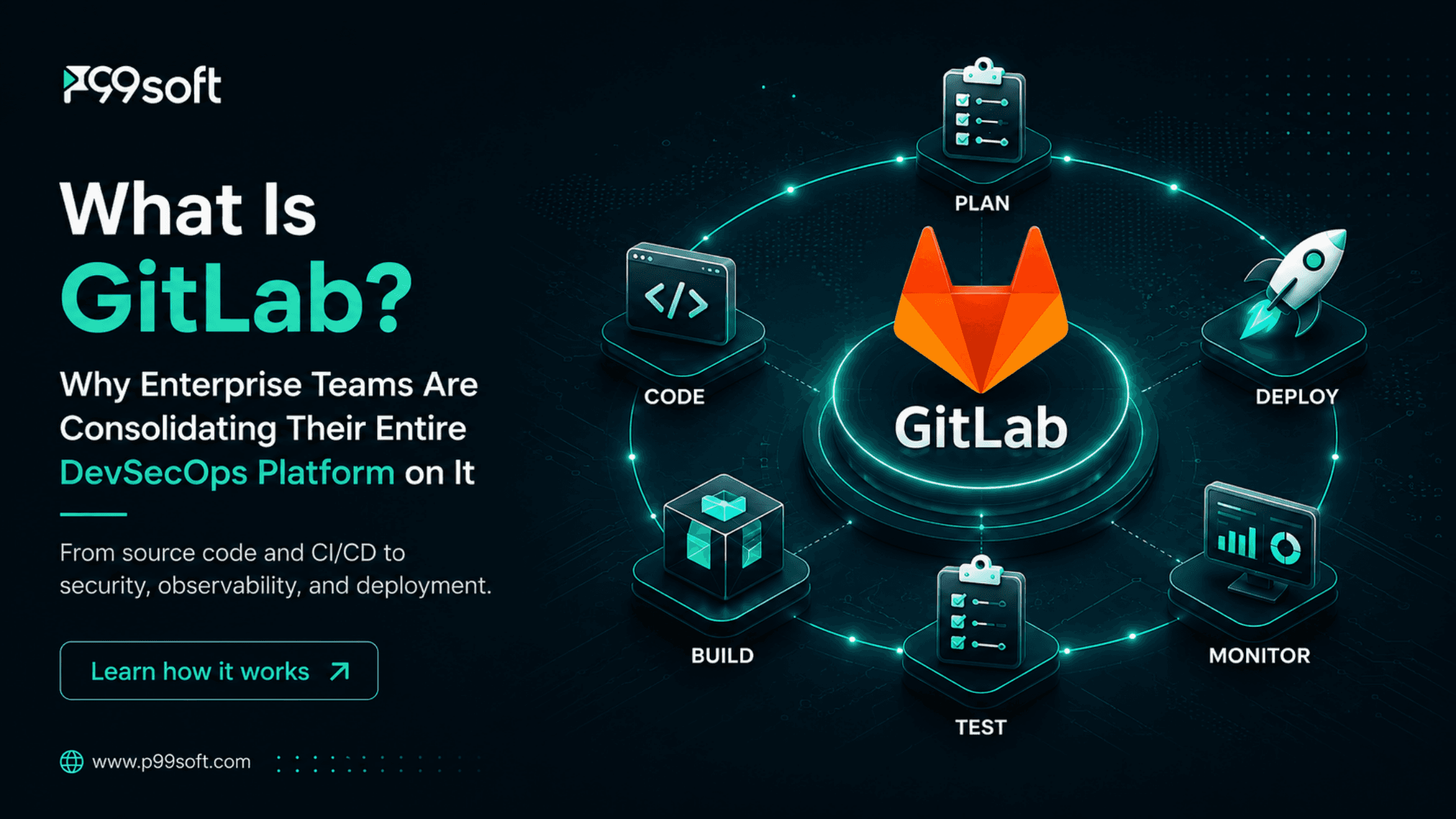
GitLab has 50 million or more users and was named a 2025 Gartner Leader, ranking first in four of six use cases in the Gartner Magic Quadrant for DevOps Platforms. More than 50% of Fortune 100 companies use GitLab, and the platform reported 26% year-over-year revenue growth in fiscal year 2026.
Those numbers reflect something specific happening in enterprise engineering organizations. The conversation has shifted from "should we adopt DevSecOps?" to "which platform do we run it on?" And the answer, for a growing number of regulated, compliance-conscious, or simply operationally mature organizations, is increasingly a single integrated platform rather than a collection of best-of-breed tools stitched together with integrations.
Practitioners report losing approximately 7 hours per week to inefficient processes, which is a measurable platform ROI anchor according to GitLab's own DevSecOps report. That 7 hours disappears into context switching between tools, maintaining integrations between systems that were not designed to work together, and debugging pipeline failures that trace back to the seam between two tools rather than to the code being delivered.
GitLab's commercial argument and its operational argument are the same: the seams between tools are where time, security coverage, and developer experience get lost. A platform where every capability shares a common data model from day one eliminates those seams.
What GitLab Actually Is
GitLab is a single application that covers the complete software development and delivery lifecycle. Source code management, continuous integration, continuous delivery, security scanning, package management, container registry, and release management are all built into one platform, sharing one data model, one authentication system, one audit log, and one interface.
GitLab's core strength is its integrated DevSecOps platform, and in 2026 that integration advantage has never been more commercially significant. Eight or more security scan types are built into every paid tier without additional per-user licensing, providing enterprises with a comprehensive security posture at a predictable cost that simplifies budgeting and procurement.
The philosophical difference between GitLab and its primary competitor is clear and worth stating plainly. GitHub believes the best platform is one that integrates best-of-breed tools through a rich marketplace. GitLab believes the best platform is one where every tool shares a common data model from day one. Neither philosophy is wrong.
For an engineering organization that is comfortable owning the selection, integration, and maintenance of individual tools, GitHub's marketplace approach provides flexibility. For an engineering organization that wants a single vendor relationship for the full lifecycle, that wants built-in security scanning without per-user add-on licensing, or that needs to run its entire platform in a self-managed environment for compliance reasons, GitLab's integrated model is the operationally simpler choice.
GitLab is not a GitHub alternative with a CI/CD system bolted on. It is a full DevSecOps platform built from the ground up on the premise that the entire software delivery lifecycle should share a common data model, and that security should be intrinsic to that model rather than an integration from a third party.
What GitLab Replaces in a Typical Enterprise Stack
The consolidation case for GitLab becomes concrete when mapped against what a typical enterprise engineering organization runs before adopting a single platform.
Source code management is typically GitHub, Bitbucket, or a self-managed Git server. GitLab provides this natively, including merge requests, code review, branch protection, and the repository management features that most development workflows depend on.
CI/CD pipelines are typically Jenkins, GitHub Actions, CircleCI, or Azure Pipelines. GitLab CI/CD is built into the platform. Pipelines are defined in the same repository as the code they build. The pipeline configuration, the code it tests, and the security scan results it generates all live in the same project, with the same audit trail.
Security scanning is typically a collection of separate tools: a SAST scanner, a dependency vulnerability scanner, a container image scanner, and a secret detection tool, each integrated into the CI/CD pipeline separately and each reporting results to a different place. GitLab reported 27% year-over-year revenue growth to 214.5 million dollars in Q1 2026, with integrated scanning tiers as a primary driver. Over 50% of organizations now run SAST, 44% run DAST, and around 50% scan containers and dependencies. GitLab provides all of these built into the platform at the Ultimate tier, reporting results into a unified Security Dashboard rather than to separate tool-specific interfaces.
Container registry is typically a separate service: Docker Hub, AWS ECR, Google Artifact Registry, or a self-hosted registry. GitLab includes a built-in container registry that stores images in the same platform as the pipelines that build them.
Package management for npm, Maven, PyPI, NuGet, and other package formats is typically handled by Artifactory, Nexus, or cloud provider package repositories. GitLab's Package Registry handles all of these within the platform.
The question worth asking before the next toolchain renewal is not which individual tool is best at each function. It is what the seams between those tools cost in maintenance overhead, integration failures, context switching, and security coverage gaps every week.
GitLab CI/CD: What Makes It Distinct at Enterprise Scale
GitLab's DAG pipeline execution model delivers measurable performance advantages for complex CI/CD workflows, with documented customer outcomes including 400% increases in automated code checks and 50% reductions in feedback loop duration.
A DAG, or Directed Acyclic Graph, is a pipeline execution model where jobs can declare their specific dependencies rather than being constrained to run in sequential stages. A test job that depends only on the build job can run immediately when the build completes, without waiting for other build-stage jobs that it does not depend on. This granular dependency model reduces pipeline execution time on complex workflows significantly compared to traditional stage-based pipelines where every job in a stage must complete before any job in the next stage can start.
GitLab Runners, the agents that execute pipeline jobs, can be self-hosted on any infrastructure: cloud virtual machines, Kubernetes clusters, bare metal servers, or the organization's own hardware. GitLab's self-managed offering is a single installer that bundles the full DevSecOps suite and is a major differentiator for organizations in banking, defense, healthcare, and government. For organizations with compliance requirements that prevent sending code or build artifacts to third-party cloud infrastructure, self-managed GitLab Runners executing pipelines on internal infrastructure is a capability that few competing CI/CD platforms match with equivalent completeness.
The pipeline-as-code model means the CI/CD configuration lives in the same repository as the application code, versioned together, reviewed together through merge requests, and auditable through the same commit history. A pipeline change that breaks a deployment can be traced to the exact merge request that introduced it, reviewed through the same process as any code change, and reverted through the same mechanism.
P99Soft's GitLab Partnership covers the full implementation lifecycle: initial GitLab setup and migration from existing source control and CI/CD systems, Runner infrastructure design and configuration, pipeline template development, security scanning integration, and the organizational practices that make the platform adoption durable rather than technically correct but organizationally ignored.
GitLab for Security: Built In Versus Bolted On
The distinction between security built into a platform and security bolted onto a platform is operational rather than philosophical. Built-in security produces scan results where they are most actionable. Bolted-on security produces scan results where the tool sends them, which is often a separate interface that developers do not regularly visit.
GitLab's integrated security scanning places results directly in the merge request that introduced the finding. A developer who opens a merge request and sees a SAST finding flagged in the same interface where they see the code review comments is a developer who can address the finding in the same context they wrote the code. A developer who must navigate to a separate security dashboard to find findings from a code change they submitted last Tuesday is a developer whose security feedback loop is too long to be effective.
97% of organizations are using or planning to use AI in the software development lifecycle, so governance must cover AI-assisted change flow. 85% say agentic AI works best with platform engineering, which ties AI gains to standardized gates, evidence, and ownership.
This is where GitLab's 2026 AI roadmap connects directly to the security posture. GitLab's 2025 monthly releases tell a clear story: the platform is moving from AI features sprinkled in to an AI-governed, agentic DevSecOps workflow while simultaneously tightening software supply chain controls. Duo Self-Hosted became generally available, allowing enterprises to run selected LLMs in their own infrastructure for code suggestions and chat, explicitly addressing data sovereignty concerns.
An AI-assisted code review that runs automatically on every merge request, flagging both code quality issues and security vulnerabilities before a human reviewer sees the PR, reduces the security review burden on senior engineers while catching more issues earlier than manual review processes can.
GitLab for Regulated and Compliance-Heavy Industries
The self-managed deployment model is where GitLab separates most clearly from cloud-only DevSecOps platforms.
Organizations in financial services, healthcare, government, and defense often face requirements that prevent certain categories of code and build artifacts from residing on third-party cloud infrastructure. A hospital system building clinical software may not be able to send patient data-adjacent code to a SaaS CI/CD platform. A defense contractor may need to run its entire development pipeline in an air-gapped environment with no external network connectivity.
GitLab Dedicated for Government earned FedRAMP Moderate authorization, enabling accelerated public sector adoption. Strategic partnerships including Sigma Defense's implementation reduced US Navy software deployment times from months to days.
This compliance capability connects directly to the partnership ecosystem that P99Soft maintains alongside its GitLab practice. Multi-cluster Kubernetes governance through SUSE Rancher Solutions provides the infrastructure layer that GitLab's Kubernetes deployment targets run on, particularly in edge and regulated environments where SUSE Rancher's support for air-gapped Kubernetes deployments is a compliance requirement.
Network security policy enforcement through Tigera Partnership complements the GitLab security scanning layer by enforcing zero-trust networking between the services that GitLab pipelines deploy. Security scanning catches vulnerabilities in code before deployment. Network policy enforcement contains the blast radius if a vulnerability reaches production. Both layers working together produce a defense-in-depth posture that neither provides independently.
GitLab vs GitHub: The Honest Comparison
The fundamental difference is philosophical. GitHub operates like a microservices architecture for DevOps, where every piece can be swapped out, while GitLab follows an integrated approach that reduces context switches. GitHub operates on the principle of composability. You can wire Jenkins, CircleCI, or native Actions into the same repo while picking from the extensive Marketplace.
Beyond individual perspectives, the broader developer community sentiment in 2026 reflects a pragmatic bifurcation: GitHub for developer-centric workflows, community engagement, and AI-assisted velocity; GitLab for enterprise-grade DevSecOps, compliance requirements, and organizations that want a single vendor for the full lifecycle.
GitHub commands approximately 37.98% of the source code management market while GitLab holds 16.20%. But raw market share obscures where the real competition is happening.
The competition for enterprise contracts is not the same as the competition for total user count. GitHub's market share includes the enormous open-source developer community using GitHub.com for free. GitLab's commercial enterprise business, growing at 26% year-over-year, reflects the specific segment of the market that is paying for DevSecOps platform capabilities rather than for source code hosting.
For engineering organizations evaluating the choice, three questions produce a more reliable decision than any feature matrix.
Do you want best-of-breed flexibility with integration maintenance overhead or do you want platform cohesion with predictable licensing? If you value flexibility and have the platform engineering capacity to maintain integrations, GitHub's marketplace approach serves you well. If you value cohesion and want security scanning, container registry, and package management included without additional contracts, GitLab is the more operationally efficient choice.
Do you need self-managed deployment for compliance reasons? If your regulatory environment requires on-premise or air-gapped deployment of the full DevSecOps platform, GitLab's self-managed option is significantly more mature than the alternatives.
How important is built-in security scanning without per-user add-on licensing? GitLab includes eight security scan types at the Ultimate tier. GitHub Advanced Security is a separate product with separate pricing. For organizations running security scanning across hundreds of developers, the licensing model difference is meaningful.
How GitLab Fits Into the Broader Platform Engineering Stack
GitLab is the delivery and security layer in a platform engineering stack. It produces the artifacts, the audit trail, and the security scan results. The infrastructure layer beneath it determines where those artifacts run and how securely they operate once deployed.
The API management layer that sits at the edge of the system determines how the services GitLab deploys are accessible and protected. Solo Consulting provides the Gloo Gateway and Gloo Mesh implementation that manages API routing, traffic management, and service mesh configuration for the services GitLab's pipelines deploy to Kubernetes. The deployment pipeline and the runtime infrastructure need to be designed together, and the P99Soft partnership network covers both.
Edge security through Akamai Partnership protects the user-facing endpoints that those deployed services ultimately serve. A GitLab pipeline that delivers well-tested, security-scanned application code to a Kubernetes cluster, sitting behind Akamai edge security for DDoS protection and WAF enforcement, represents a defense-in-depth architecture where each layer contributes protection that the others do not provide independently.
FAQ
What is GitLab and how is it different from GitHub?
GitLab is a complete DevSecOps platform that covers source code management, CI/CD pipelines, security scanning, container registry, package management, and release management in a single application. GitHub is primarily a source code management and CI/CD platform that integrates with third-party tools for other capabilities. The key difference is integration depth: GitLab provides security scanning, container registry, and package management as built-in features sharing a common data model, while GitHub provides these through marketplace integrations with separate products and separate pricing. GitLab ranked first in the 2025 Gartner Magic Quadrant for DevOps Platforms and is used by over 50% of Fortune 100 companies.
Why are enterprise teams consolidating on GitLab in 2026?
Enterprise teams are consolidating on GitLab because maintaining five to eight separate tools for source control, CI/CD, security scanning, container registry, and package management creates integration overhead, security coverage gaps, and context switching costs that compound as the engineering organization grows. GitLab's integrated platform eliminates the seams between tools, places security findings directly in the merge request where developers can act on them, and provides a single audit trail across the entire delivery lifecycle. Practitioners report losing approximately 7 hours per week to inefficient toolchain processes, which represents measurable ROI from consolidation.
What security scanning does GitLab include?
GitLab includes eight or more security scan types in its Ultimate tier without additional per-user licensing: Static Application Security Testing (SAST) for source code vulnerabilities, Dynamic Application Security Testing (DAST) for running application testing, dependency scanning for third-party library vulnerabilities, container image scanning for base image and layer CVEs, secret detection for accidentally committed credentials, infrastructure as code scanning for misconfiguration, license compliance scanning for open-source license policy enforcement, and API security testing. Results appear directly in merge requests and aggregate in a unified Security Dashboard rather than in separate tool-specific interfaces.
Is GitLab available for self-managed deployment in regulated industries?
Yes. GitLab's self-managed deployment option bundles the complete DevSecOps platform in a single installer that runs on the organization's own infrastructure, including air-gapped environments with no external network connectivity. This is a primary adoption driver for financial services, healthcare, defense, and government organizations with compliance requirements that prevent certain categories of code or build artifacts from residing on third-party cloud infrastructure. GitLab Dedicated for Government has earned FedRAMP Moderate authorization, and the platform's self-managed option is significantly more mature than competing platforms for regulated industry deployment.
Author Name - Mrunalini Wankhede