What Is Game Prototyping and Why Every Studio Should Do It Before Full Production

Game prototyping is the practice of building a quick, rough, playable version of a game to test whether its core mechanics are actually fun and technically feasible, before committing the time and budget of full production. A prototype uses placeholder art and simplified systems to focus entirely on the core gameplay loop. It matters because production is where 60 to 70 percent of a game's budget goes, and a prototype answers the one question you cannot fake, is this fun to play, while it is still cheap to change the answer.
Every game starts as an idea that feels brilliant in someone's head. The problem is that a feeling in someone's head is not proof. Whether a mechanic is genuinely fun, whether players will stay past the first ten minutes, whether the thing that sounds exciting in a pitch actually holds up with a controller in hand, none of that is knowable until someone plays it. Prototyping is how you find out, before you have spent months and a fortune building on an assumption.
The industry has quietly made prototyping a discipline rather than an afterthought. According to Unity's 2026 Game Development Report, 46 percent of studios now spend between one and three months on prototyping, 21 percent spend less than a month, and nearly half of studios, 48 percent, have become more selective in the last year about which prototypes they develop into full games. That last number is the important one. Studios are no longer just building prototypes. They are using prototypes to decide what not to build, which is where the real value lives.
This piece explains what game prototyping actually is, what it validates, and why building one before full production is one of the highest-leverage decisions a studio can make. Whether you are a founder with an idea, a studio weighing a new project, or a publisher deciding where to place a bet, understanding prototyping is understanding how good games avoid becoming expensive mistakes.
What Game Prototyping Actually Is
Game prototyping is the practice of building a quick, functional, playable version of a game to test its core ideas before committing to full production. The goal is not to build a small version of the finished game. It is to answer specific questions about whether the game is worth building at all.
A prototype is deliberately rough. It uses placeholder art, simplified systems, and the bare minimum needed to make the core idea playable. A prototype for a platformer might be nothing more than a plain character shape, basic movement, and a few test levels built to validate whether the jump physics feel right and the level design works. There is no story, no polish, no menus, no sound design worth mentioning. Everything that is not the core question gets stripped away, so the prototype tests the one thing that matters and nothing else.
This is what separates a prototype from other early builds. It is focused entirely on validation. The prototype exists to answer a question, and once it has answered that question, it has done its job. Prototypes are time-boxed, typically to two to four weeks, with clear success criteria defined before building starts: the specific mechanics to validate, the performance targets to hit, and an honest assessment of the fun factor from playtesting. If the prototype reveals a fundamental flaw in the concept, the studio pivots or refines before moving to production, which is exactly the outcome a prototype is meant to produce.
There are different kinds of prototypes for different questions. A gameplay prototype tests whether the core loop is fun. A technical prototype validates that the chosen engine and technology can actually handle the game's requirements, whether that is networking for a multiplayer game, procedural generation, AI pathfinding at scale, or a demanding rendering technique. An art style prototype explores how the game should look and, crucially, whether that look serves the gameplay. Most projects need more than one, because "is it fun," "can we build it," and "how should it look" are three different questions that a single build rarely answers well.
A game prototype is a quick, rough, playable build made to validate a specific question, usually whether the core mechanic is fun or technically feasible. It strips away everything that is not the question being tested, which is what lets it deliver a clear answer fast and cheap.
Why Prototyping Belongs Before Full Production
To understand why prototyping matters so much, you have to understand where a game's budget and time actually go. Production, the phase where the game gets fully built, consumes 60 to 70 percent of a game's total development timeline and budget. Pre-production, which includes prototyping, is only 10 to 15 percent. The math is the whole argument: prototyping is the cheap phase where you decide whether the expensive phase is worth starting.
When a studio skips prototyping and moves straight into production, every assumption about the game goes untested into the most expensive part of development. Whether the core loop is fun. Whether the art style holds up in motion. Whether the technology can handle the game's demands. The studio finds out the answers months into production, when changing course means unwinding work that took a team weeks to build. A flaw caught in a two-week prototype is a note. The same flaw caught six months into production is a crisis.
This is why the industry has shifted toward a "fail-fast" philosophy. 67 percent of developers now spend three months or less in the prototyping phase, prioritizing fast, cheap experimentation over heavy initial investment. The logic is that it is far better to learn a concept does not work after two weeks of prototyping than after six months of production. Failing fast is not pessimism. It is a way of spending a small amount to avoid spending a large amount on the wrong thing.
The economic pressure makes this more important than ever. The game industry has been through significant turbulence, with over one in four industry professionals laid off in the past two years and studios under real pressure to manage risk. In that climate, studios are prioritizing smaller-scale, focused player experiences and being far more disciplined about what they commit to. A prototype is the discipline mechanism. It is how a studio proves an idea deserves a full budget before that budget gets committed, which matters enormously when budgets are tight and a wrong bet can threaten the whole studio.
Strong pre-production, with validated prototypes at its center, prevents costly mistakes, reduces scope creep, and ensures the whole team shares a unified vision of what they are building. The prototype is not a delay before the real work begins. It is the work that makes the real work worth doing.
The One Question a Prototype Answers That Nothing Else Can
Of everything a prototype validates, one thing towers above the rest, and it is the thing no design document, no pitch deck, and no amount of planning can ever tell you: is the game actually fun to play?
Fun is uniquely resistant to prediction. A mechanic can look brilliant described in a design document, sound exciting in a pitch, and feel completely flat the moment someone actually plays it. The reverse happens too, where a simple idea nobody was excited about turns out to be genuinely compelling in the hand. There is no way to know which you have until the game is playable, because fun is an experience, not a specification. You cannot read it off a page. You have to feel it.
This is why the fun factor assessment from playtesting is a core deliverable of the prototyping phase. The prototype gets put in front of real people, and their genuine reaction, not their polite feedback but whether they actually keep playing, is the signal. A prototype that players put down after two minutes has told you something priceless, and it has told you while the fix is still cheap. A prototype that players keep reaching for, even in its rough placeholder state, has validated the single most important thing about the entire project.
The core loop is usually what gets tested first, because it is the heart of the game. The core loop is the sequence of actions a player repeats over and over, and if that loop is not satisfying, no amount of story, art, or content built on top of it will save the game. Getting the core loop right is the foundation, and a prototype is how you confirm the foundation is solid before you build the house on it.
This validation-first mindset is exactly how P99Soft's game studio approaches prototyping. We build quick, functional prototypes to test the mechanics, the visuals, and the idea itself with minimal risk, so studios and founders can prove the fun is real before committing to full production. The prototype is where "we think this will be fun" becomes "we have watched people play it and we know," which is a completely different footing to build a game on.
What Else a Prototype Validates: Art, Technology, and Feasibility
While fun is the headline question, a good prototyping phase validates several other things that are just as capable of sinking a project if left untested until production.
The art style, tested against real gameplay.
Choosing an art style is one of the most consequential decisions in a game, because every asset gets built in that style and committing to the wrong one can mean rebuilding months of work. The trap is that a style can look stunning in a static concept frame and then fail in motion, flattening the tension, obscuring the action, or slowing how quickly players can read a fast-moving screen. An art style prototype tests the look against the actual mechanics, so the studio commits to a visual direction with proof that it strengthens the game rather than fights it. This is a big enough discipline on its own that it connects directly to how studios approach art production, which our guide to game art outsourcing covers in depth, including how validating the style early prevents the expensive rework of discovering the wrong direction halfway through production.
The technology, proven capable of the vision.
A technical prototype confirms that the chosen engine and technology stack can actually deliver what the game needs. This matters most for games with demanding technical requirements, and nowhere more than in multiplayer. Networking is notoriously difficult, and a game whose entire concept depends on smooth multiplayer needs to prove that the net code and architecture can deliver before the design is built around it. Validating the hardest technical systems early, rather than assuming they will work, is what separates a technically feasible game from an ambitious one that collapses under its own requirements. For multiplayer games specifically, this is foundational, which is why understanding what makes a scalable multiplayer game architecture work belongs in the prototyping conversation, because the architecture decisions validated in a technical prototype shape everything built afterward.
The scope, checked against reality.
Prototyping also reveals whether the game the studio wants to build is the game the studio can actually build with the time and resources available. A prototype makes the real cost of the core systems visible, which lets the studio make honest scope decisions before production rather than discovering mid-production that the vision was larger than the budget. This is how prototyping reduces the scope creep that derails so many projects.
Together, these validations turn a collection of assumptions into a set of proven facts. By the end of a good prototyping phase, the studio knows the game is fun, knows the art direction works, knows the technology can deliver, and knows the scope is realistic. That is a dramatically stronger position to enter production from than a design document and a hope.
The Game Prototyping Process, Step by Step
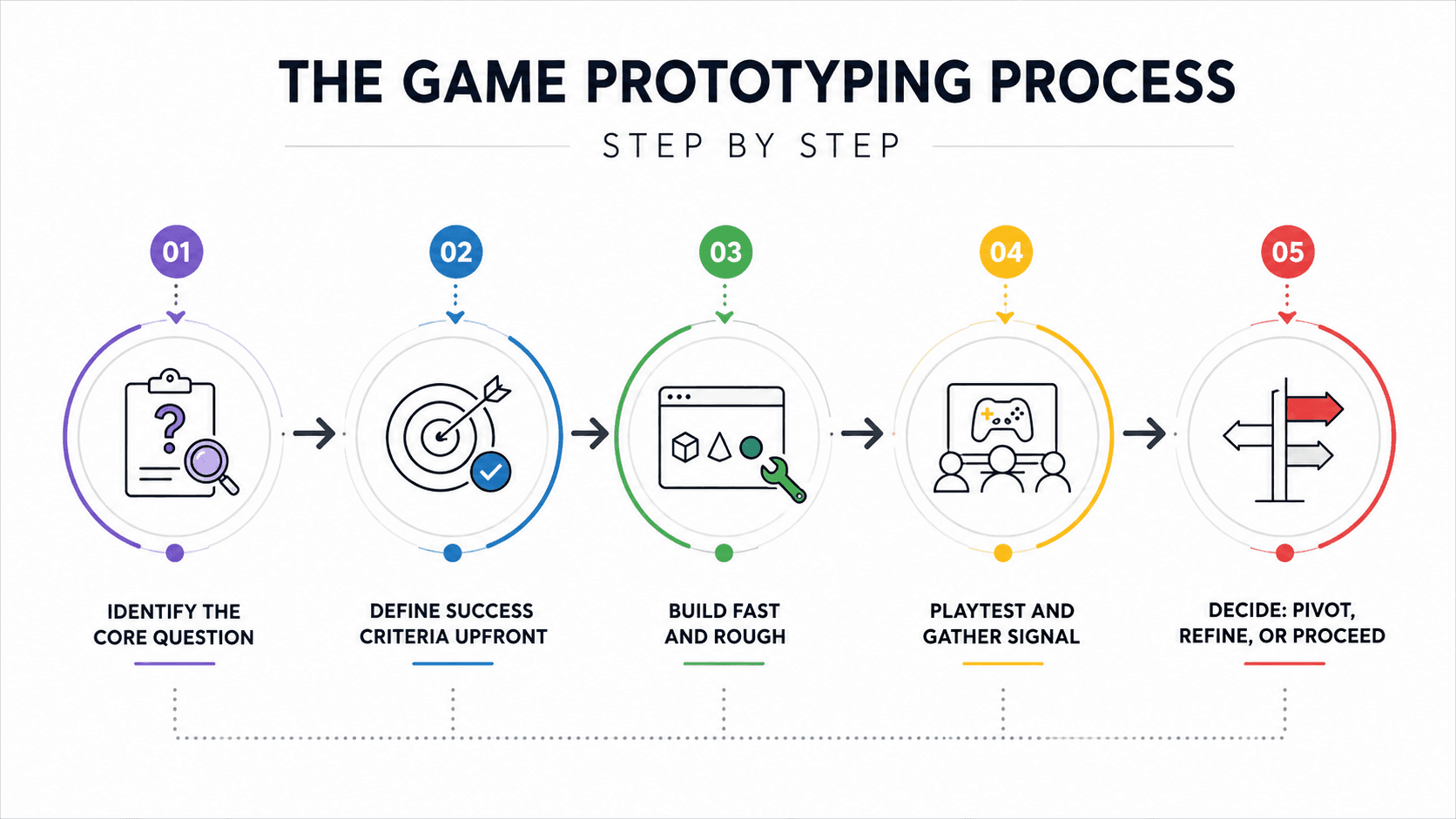
Prototyping is not chaotic experimentation. The studios that get the most from it follow a clear process, and understanding that process demystifies what actually happens between an idea and a validated concept.
Start by identifying the core question.
Before building anything, the studio defines what the prototype needs to prove. Usually this is the game's core pillar, the single most important mechanic or experience that makes the game unique. Naming the core question focuses the entire prototype on validating the thing that matters most, rather than spreading effort across everything.
Define success criteria upfront.
A prototype needs a clear definition of what success looks like before building starts. What specific mechanics must be validated, what performance targets must be hit, and how the fun will be assessed. Without defined criteria, a prototype produces opinions rather than answers, and the whole point is to get an answer.
Build fast and rough, focused only on the question.
With the question and criteria set, the studio builds the minimum needed to test them, using placeholder art and simplified systems. Everything that does not serve the core question gets left out. The build is deliberately quick, time-boxed to a few weeks, because speed is the point and polish is the enemy at this stage.
Playtest and gather honest signal.
The prototype gets played, ideally by people who will react genuinely rather than politely. The studio watches what actually happens: whether players keep playing, where they lose interest, whether the mechanic clicks. This is where the prototype earns its keep, turning assumptions into observed reality.
Decide: pivot, refine, or proceed.
The prototype's results drive a clear decision. If it revealed a fundamental flaw, the studio pivots or refines the concept before going further. If it validated the idea, the studio moves toward production with genuine confidence. Increasingly, studios are also willing to make the hardest decision, to shelve a prototype that did not work, which is exactly the selectivity that 48 percent of studios have adopted in the past year.
This process is what P99Soft's game studio runs when building prototypes for studios, founders, and publishers: identify the core question, define what proof looks like, build a focused playable concept fast, test it with real players, and produce a clear answer about whether the idea is worth full production. The output is not just a build. It is a decision made on evidence rather than instinct.
When You Should Prototype and When You Might Not Need To
Prototyping is valuable, but it is worth being clear about when it matters most and when a lighter touch is enough, because part of doing prototyping well is knowing how much of it a given project actually needs.
You should prototype when the game rests on an unproven core mechanic, when the fun is not obvious, or when the concept does something new that has no existing template to reference. The more novel and the more the game depends on a specific feel, the more essential the prototype, because novelty is exactly what cannot be validated any way except by playing it. A game built around an original mechanic without a prototype is a large bet placed blind.
You should also prototype when the technology is genuinely uncertain. If the game depends on a demanding technical system, complex multiplayer, heavy procedural generation, an ambitious rendering approach, a technical prototype that proves the technology works is essential before designing around it. The cost of discovering the technology cannot deliver, after the game has been built assuming it can, is severe.
The case for a lighter prototyping effort exists when a studio is building something well within familiar territory, using a proven mechanic they have shipped before, in an established genre, on technology they know handles it. Even then, some validation is wise, but the depth of prototyping needed is lower because fewer things are genuinely uncertain. The rule of thumb is that prototyping effort should scale with uncertainty. The more unknowns, the more prototyping earns its cost.
What is almost never wise is skipping validation entirely on a game that depends on an unproven idea. The whole industry data points one direction: studios are becoming more selective, prototyping is becoming more streamlined and more valued, and the fail-fast philosophy exists precisely because the alternative, discovering a concept does not work deep into expensive production, is the mistake that sinks projects and studios. A prototype is cheap insurance against the most expensive mistake in game development.
For studios and founders weighing a new project, P99Soft's game studio builds the quick, functional prototypes that answer these questions with minimal risk, whether that is a mechanics test to prove the core loop is fun, an art style exploration to lock the visual direction, or a full playable concept build to validate the whole idea before production begins. The goal is always the same: to know, rather than hope, before the expensive work starts.
FAQ
What is game prototyping in simple terms?
Game prototyping is building a quick, rough, playable version of a game to test whether its core idea actually works before committing to full production. The prototype uses placeholder art and simplified systems, and it focuses entirely on answering a specific question, usually whether the core mechanic is fun to play or whether the technology can handle the game's requirements. It is deliberately unpolished because polish is not the point; validation is. A prototype is typically time-boxed to two to four weeks with clear success criteria defined before building starts. Once it has answered its question, whether the answer is "this works, proceed" or "this doesn't, pivot," the prototype has done its job.
Why is prototyping important in game development?
Prototyping is important because production, where a game is fully built, consumes 60 to 70 percent of the total budget and timeline, while prototyping is part of the 10 to 15 percent spent on pre-production. Prototyping is the cheap phase where you decide whether the expensive phase is worth starting. It answers the one question that no design document can, which is whether the game is actually fun to play, and it validates the art direction and technology before the studio commits to building on them. Catching a fundamental flaw in a two-week prototype costs a fraction of catching the same flaw six months into production. This is why 67 percent of developers now embrace a fail-fast approach, using quick prototypes to learn what works before investing in full production.
How long does game prototyping take?
Game prototyping is usually time-boxed to two to four weeks per prototype, with clear success criteria defined before building begins. At the studio level, 46 percent of studios spend between one and three months on prototyping overall, and 21 percent spend less than a month, with 67 percent of developers spending three months or less. The exact duration depends on how many questions need validating and how complex the core systems are. The key principle is that prototyping should be fast and focused. It is meant to produce a clear answer quickly, not to gradually become the finished game. If a prototype is dragging on for many months, it has usually stopped being a prototype and started becoming premature production.
What is the difference between a game prototype and a full game?
A prototype is a rough, focused build made to validate a specific question, while a full game is the polished, complete product players actually buy. A prototype uses placeholder art, simplified systems, and only the bare minimum needed to test its core question, whether that is a mechanic's fun factor or a technology's feasibility. It has no story, polish, or content beyond what the test requires. A full game, built during the production phase that consumes 60 to 70 percent of the budget, includes finished art, complete systems, story, audio, polish, and all the content that makes a shippable product. The prototype exists to prove the idea is worth building; the full game is the result of actually building it once the prototype has confirmed it is worth the investment.
Authors Name - Rahul Pawar and Mrunalini Wankhede