How to Choose a Game Art Outsourcing Studio and Build a Production Pipeline That Actually Delivers
Why Game Art Outsourcing Has Become a Standard Part of Game Production
Game art outsourcing is no longer something only small studios do to cut costs. It is how most of the gaming industry actually ships games. According to recent industry data, nearly 70 percent of game developers now use some form of outsourcing in their production workflow. The global game art outsourcing market reached approximately 3.77 billion dollars in 2025 and is projected to grow past 4.2 billion in 2026. Studios of every size, from indie teams with five people to publishers shipping titles to hundreds of millions of players, rely on external art partners to move faster and maintain quality at the same time.
The reason is practical. Building a full in-house art team across concept, 2D, 3D, rigging, animation, and UI is expensive, slow, and inflexible. A project that needs 40 artists during pre-production might need 8 during post-launch content updates. You cannot hire and fire that way. An outsourcing studio gives you a production-ready team that scales with your project without the overhead of permanent headcount.
But choosing the wrong game art outsourcing studio is one of the most expensive mistakes a studio can make. Art created outside a proper pipeline breaks inside game engines, does not match the visual style of your game, and creates revision cycles that cost more time than building in-house would have. The decision deserves more care than most studios give it.
What a Game Art Outsourcing Studio Actually Does
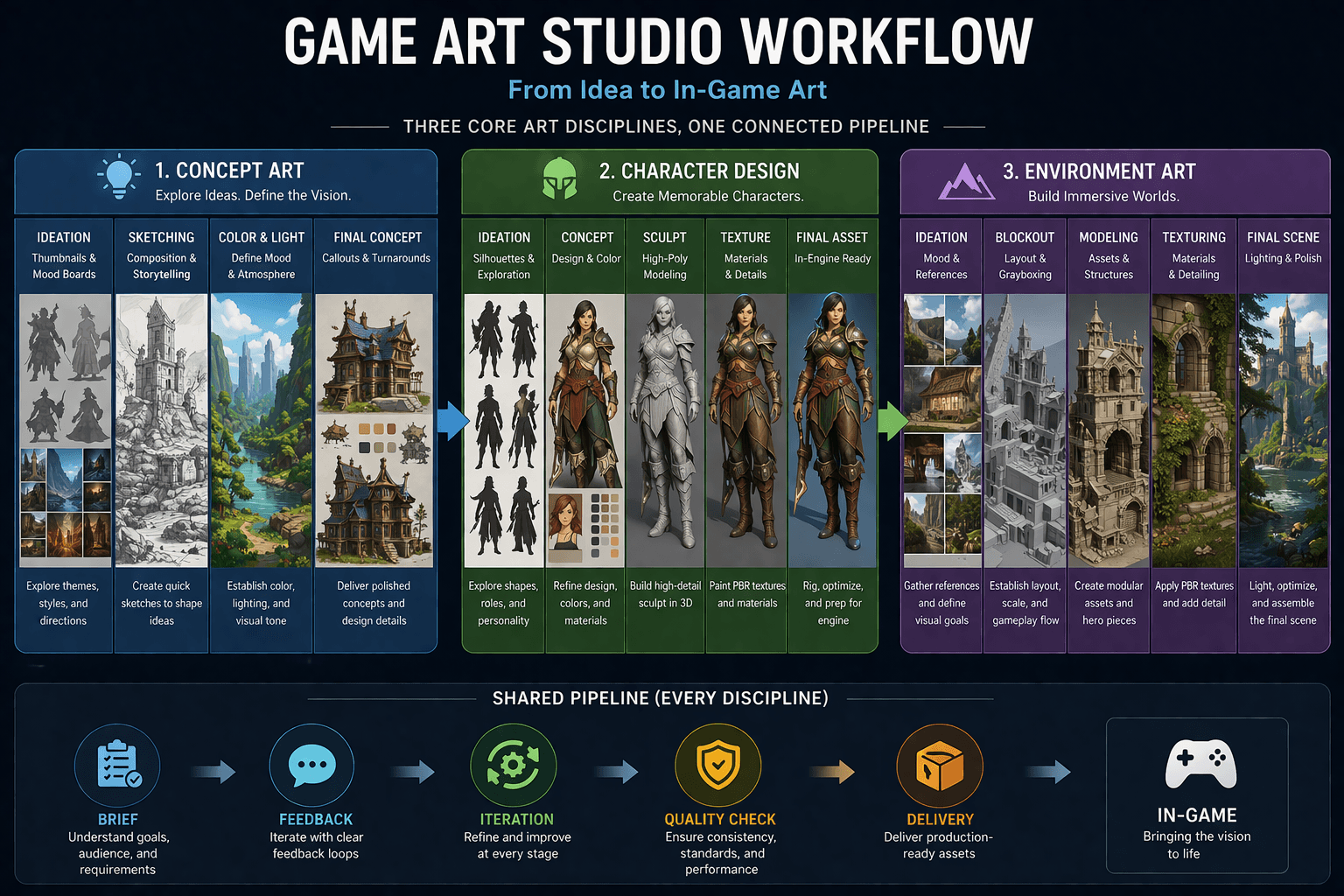
The term covers a wide range of work, and understanding exactly what you need before you start searching saves weeks of wasted conversations.
Concept art and illustration is where a game's visual identity begins. A strong outsourcing studio takes your creative direction, references, and tone and translates them into concrete visual language before any 3D work begins. Good concept art answers questions that would otherwise slow down every subsequent stage of production.
2D art production covers character sprites, environment backgrounds, UI elements, icons, and any flat visual assets the game uses. 2D art outsourcing represents roughly 45 percent of the contracted volume in the market. It is particularly important for mobile games, casual games, and stylized titles where 2D assets drive most of the player's visual experience.
3D modeling and texturing is the largest segment, making up approximately 55 percent of outsourced art work. A 3D character asset for a mobile game can require six to ten distinct production steps before it is ready for the engine, including modeling, UV unwrapping, texturing, normal map baking, rigging setup, and LOD creation. Studios that understand this full chain produce assets that actually work in production rather than looking good in isolation.
Character and environment art require a different skill set from each other. Character artists think about silhouette, readability at small sizes, and movement. Environment artists think about how spaces feel, how players navigate them, and how lighting interacts with the materials. A studio that claims to do both well needs to show you portfolio work in both categories, separately.
Beyond production, a good game art outsourcing studio also helps manage the art bible, style guide, and asset naming conventions. These things sound administrative but they are what make a large art project stay consistent across months and multiple artists.
The Right Way to Evaluate a Game Art Outsourcing Studio
Most studios pick the wrong partner for one of three reasons. They look only at the portfolio without testing the pipeline. They choose based on price without understanding what drives quality. Or they skip reference checks and discover communication problems three months into production when replacing the studio is not an option.
Here is how to evaluate properly.
Portfolio range matters more than portfolio size. You want to see work across multiple visual styles, not just one type of game. A studio that only shows dark fantasy characters might struggle with a bright mobile casual game. Look for range across styles, not just quality within one style.
Technical discipline is what separates a game art outsourcing studio from a general illustration studio. Ask specifically how they handle polycount budgets, texture atlasing, draw call optimization, and LOD chains. If the answers are vague, the assets will cause performance problems in your engine regardless of how good they look in a render.
Communication systems are as important as artistic skill. Find out how the studio structures feedback cycles. How do they handle revision requests? What happens when a milestone is at risk? How many revision rounds are included in a contract before additional charges apply? A studio that has clear answers to these questions has been through enough production to have built systems around them. One that cannot answer clearly probably has not.
Style consistency across a large asset set is harder than it sounds. Ask the studio to show you projects where they produced 200 or more assets in a single visual style. The twentieth asset and the two hundredth asset should look like they came from the same game. This is the test that eliminates most studios at the evaluation stage.
How to Structure a Game Art Production Pipeline With an External Studio
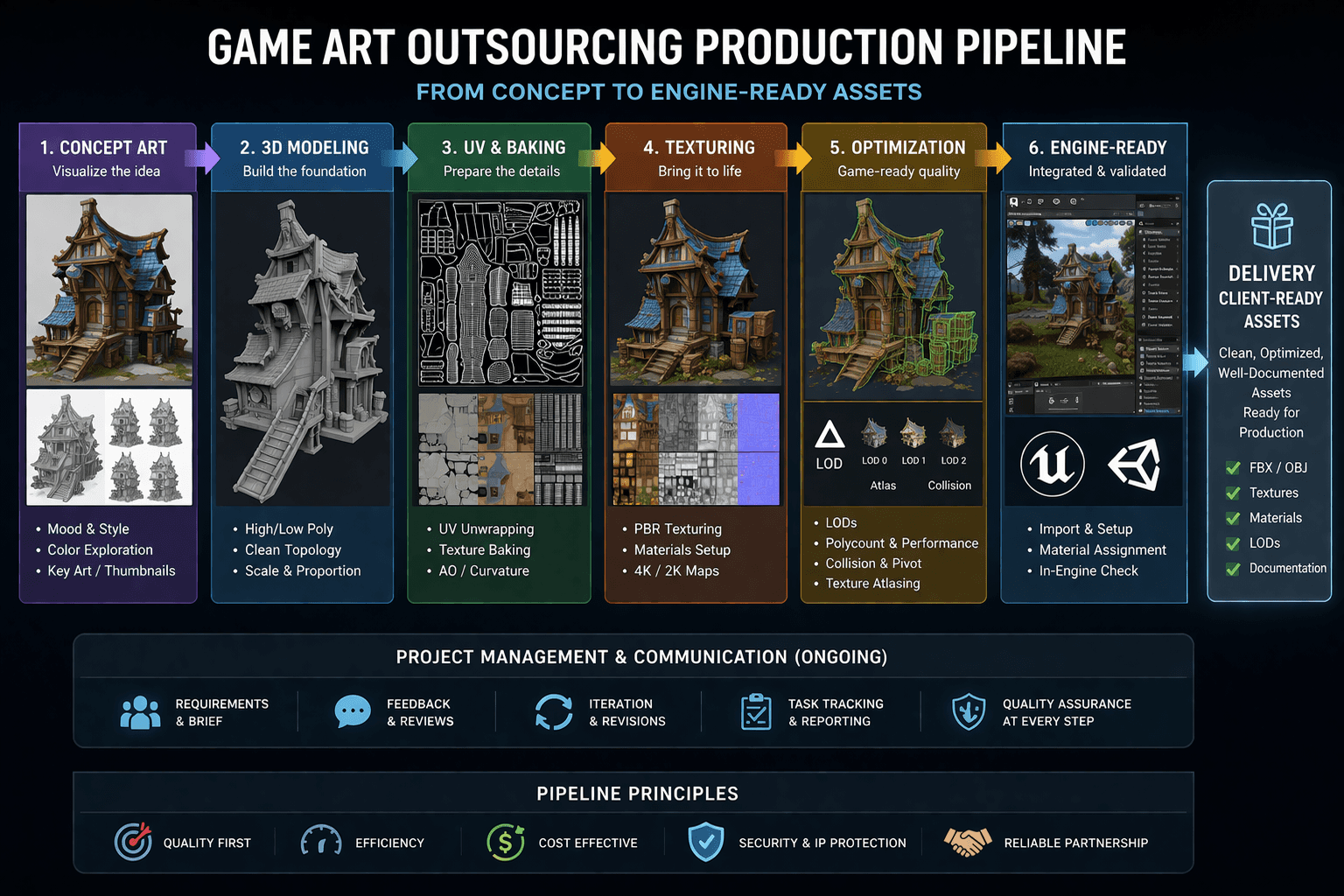
Getting the relationship right from the start prevents the most common outsourcing failures. A few structural decisions made in the first two weeks of a partnership determine whether the next six months go smoothly or collapse into revision chaos.
Start with an art bible before any assets enter production. The art bible defines color palette, style references, line weight, lighting direction, silhouette principles, and technical constraints. A studio working without a solid art bible will drift in style across the project. Every revision cycle that results from style drift is avoidable.
Use milestone-based delivery rather than delivering everything at the end. Break production into clear phases with review gates. Concept approval first. Then grey lighted 3D models. Then textured passes. Then final delivery with LODs and colliders. Each gate is a moment to catch problems before they multiply.
Assign a single point of contact on your side who owns all feedback and communicates it to the studio in one voice. Conflicting feedback from multiple people inside your team is one of the top reasons outsourced art projects fail. The studio cannot reconcile directions that contradict each other, and revision cycles spiral.
Establish naming conventions and folder structures on day one. This sounds tedious but it is what makes integrating thousands of assets into your engine manageable. An outsourcing studio that delivers assets in inconsistent naming formats creates days of additional work for your engineering team.
At P99Soft, our game art production service is built around these pipeline principles. Our concept art and illustration work establishes the visual foundation. Our 2D and 3D asset production follows structured milestone delivery with clear revision protocols. Our character and environment art teams work from shared style guides that hold consistency across the full asset set. We have applied this across mobile titles, cross-platform games, and live service products where new content has to match existing assets delivered months earlier.
What Outsourcing Game Art Actually Costs and How to Think About It
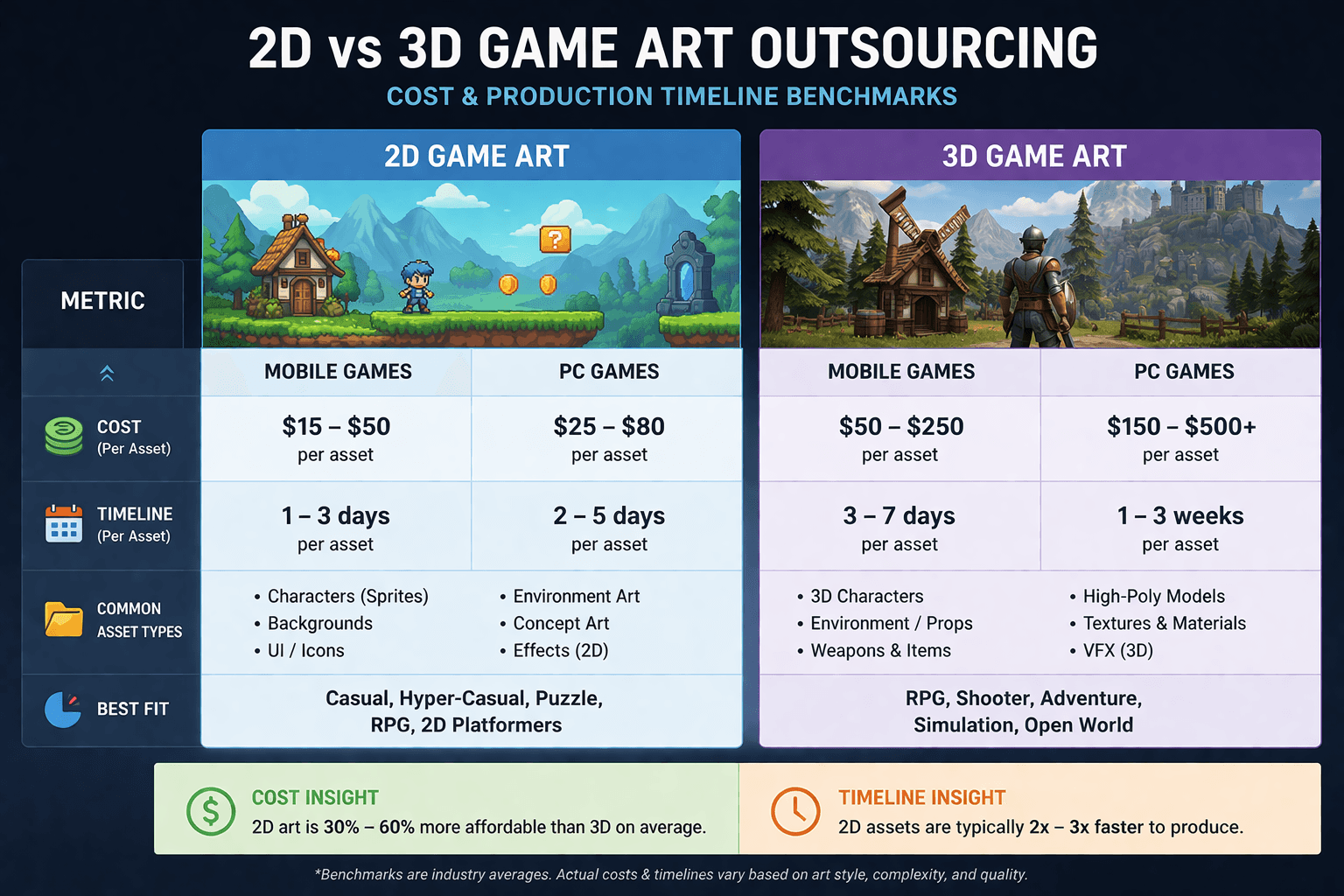
Pricing in game art outsourcing varies significantly based on asset type, complexity, geographic location of the studio, and the level of specialization required. A 3D character for a mobile game produced in India or Southeast Asia typically ranges from 500 to 2,500 dollars depending on polycount and rigging requirements. A cinematic-quality character for a AAA console title can exceed 10,000 dollars at a studio with that level of specialization.
2D game assets like UI elements, icons, and sprite sheets are typically priced per asset or per hour. Environment concept art is usually charged by the piece or by day rate, with complexity being the primary cost driver.
The correct way to think about cost is not per asset but per production outcome. A studio that charges 30 percent less per asset but requires twice as many revision cycles to hit the visual standard you need is not cheaper. It is more expensive in total. The revision time from your own team, the delays to your production schedule, and the risk of having to redo assets entirely make the lower quote misleading.
Studios that produce consistent quality on the first pass, deliver on schedule, and communicate clearly about scope changes cost more per asset and save money across the project. This is the trade-off that matters.
Common Mistakes Studios Make When Outsourcing Game Art
The most expensive mistake is starting outsourcing too late in production. When a studio waits until they are under delivery pressure before engaging an art partner, there is no time for proper onboarding, style alignment, or revision cycles. Rushed outsourcing produces rushed assets.
The second mistake is treating the outsourcing studio as a pure execution partner rather than a creative collaborator. The best results come from studios that engage their outsourcing partner in the style development phase, not just the production phase. An experienced game art team can catch visual direction problems early that would become expensive to fix later.
The third mistake is not checking how the studio handles engine integration. Art that looks perfect in a rendering software but breaks in Unreal Engine or Unity because of incorrect material setups, wrong texture formats, or missing LODs is not production-ready art. Ask directly: do they deliver engine-ready assets or render-ready assets? These are not the same thing.
The fourth mistake is ignoring time zones and workflow overlap. If your team and the outsourcing studio have no overlapping working hours, every feedback cycle takes 48 hours instead of 24. Over a six-month project, this doubles your revision cycle time. Consider studios that offer partial overlap or dedicated communication windows.
FAQ
What is a game art outsourcing studio?
A game art outsourcing studio is an external team that handles visual production for games, including concept art, 2D and 3D asset creation, character design, environment art, and animation. Studios hire them to scale production capacity, access specialized skills, or maintain quality without building large permanent art teams.
How much does it cost to outsource game art?
Costs vary widely based on asset complexity, style, and studio location. A 3D mobile game character typically ranges from 500 to 2,500 dollars. Environment art and cinematic-quality work cost significantly more. Budget for revisions as well as initial production, since revision cycles can represent 20 to 40 percent of the total cost if the studio and client are not well aligned from the start.
How do I know if a game art outsourcing studio can handle my art style?
Ask for portfolio examples that closely match your target visual style, not just their best general work. Request examples from projects that required producing more than 100 assets in a single consistent style, since consistency across large volumes is harder than producing a few standout pieces. If the studio cannot show this, they may struggle with your production volume.
What is the difference between 2D and 3D game art outsourcing?
2D game art outsourcing covers flat visual assets including sprites, UI elements, backgrounds, icons, and concept illustrations. 3D game art outsourcing covers modeled characters, environments, props, and vehicles that exist in three-dimensional space within the game engine. Many projects need both, and some studios specialize in one over the other. Always confirm which discipline the studio has the strongest track record in before committing.
If you are looking to scale your game art production without compromising on quality or timelines, partnering with the right studio makes all the difference. From concept art to fully optimized, engine-ready assets, a dedicated team can streamline your pipeline and bring your vision to life with precision. Explore how a reliable game art partner can support your next project here: https://p99soft.com/game-studio
Authors Name - Rahul Pawar and Mrunalini Wankhede