What Is DevSecOps? How to Shift Security Left Without Slowing Down Your Engineering Team
DevSecOps is the practice of integrating security into every stage of the software development lifecycle rather than treating it as a final gate before release. The shift-left principle means moving security checks earlier in the pipeline, where fixing a vulnerability costs 6 times less than fixing it in production. Organizations that implement DevSecOps report 73% fewer critical vulnerabilities in production and a 50% reduction in mean time to remediate.
Security used to live at the end of the delivery pipeline. Code was written, tested, reviewed, and then handed to a security team who would audit it before release. This model had one obvious problem: by the time the security team found a vulnerability, the code had been through every other stage of review. Fixing it meant going back to the beginning.
The average cost of a data breach hit $4.88 million in 2024, the highest on record. Software supply chain attacks surged dramatically in recent years. Yet only 36% of organizations actively practice DevSecOps today, and among those, many still treat scanning as a checkbox rather than an engineering discipline.
The DevSecOps market in 2026 is valued between $8.6 billion and $10.9 billion, driven by cloud-native architectures, regulatory pressure, and the explosion of AI-assisted coding that introduces new, hard-to-review code at scale.
The pressure to adopt DevSecOps is real. The gap between adoption and mature practice is equally real. Most organizations that claim to have implemented DevSecOps have added a security scan to the end of their CI/CD pipeline and called it done. That is not DevSecOps. That is a security audit with better tooling.
DevSecOps as a genuine engineering discipline changes when and how security decisions happen, not just which tools are running.
What DevSecOps Actually Means
DevSecOps means security is an engineering responsibility built into the delivery process, not a compliance function applied to the output of that process.
The name combines Development, Security, and Operations. The combination is deliberate. Security belongs to the same people building and operating the software, not to a separate team reviewing it after the fact. The guiding principle is called shift left: move security checks earlier, to where fixing issues is cheapest and fastest.
The cost difference between finding a vulnerability at different stages is significant. A vulnerability caught at the code commit stage costs roughly 6 times less to fix than the same vulnerability caught in production. At the commit stage, the developer who wrote the code is still in context. The fix is a code change. At the production stage, the fix requires an incident response, a patch deployment, a rollback potentially, and a postmortem. The code change is the same size. Everything around it is not.
DevSecOps adopters achieve 2.5 times faster recovery times from failures. Lead time for changes is reduced by 66% with DevSecOps. Deployment frequency increases 3 times for mature DevSecOps teams. Change failure rate drops to 0 to 15% in elite DevSecOps performers.
These numbers come from the same engineering organizations that are also moving fast. DevSecOps does not slow delivery down when it is implemented correctly. It speeds it up by catching problems before they accumulate into production incidents that cost far more time than any security gate ever did.
DevSecOps is not about adding more steps to the pipeline. It is about moving security decisions to the point in the process where they are cheapest and fastest to act on, which is almost always earlier than where they currently happen.
Why "Shift Left" Is More Than a Direction
Shift left means moving security earlier in the software development lifecycle. It is a spatial metaphor for a process change: if you draw the stages of delivery as a line from left to right, security currently lives at the right end. Shift left means moving it toward the left.
The practical meaning is that security checks run at the point of code creation rather than at the point of code deployment. A static analysis tool that catches an injection vulnerability when the developer writes the affected function is shift-left security. The same tool running as a compliance check after the code is in production is not.
36% of organizations now develop software using DevSecOps, up from 27% in 2020. 60% of rapid development teams embed practices versus 20% in 2019. Over 50% now run SAST scans, 44% run DAST, and around 50% scan containers and dependencies.
The growth is real. The distribution of where those scans run in the pipeline is the factor that determines whether they are shift-left in practice or just labeled as such. A SAST scan that runs in the final pipeline stage before production deployment is not shift-left. It is just a later-stage gate with a better tool. The scan needs to run where the feedback reaches the developer who can act on it fastest, which is the pull request stage, before review begins.
The Four Security Controls Every DevSecOps Pipeline Needs
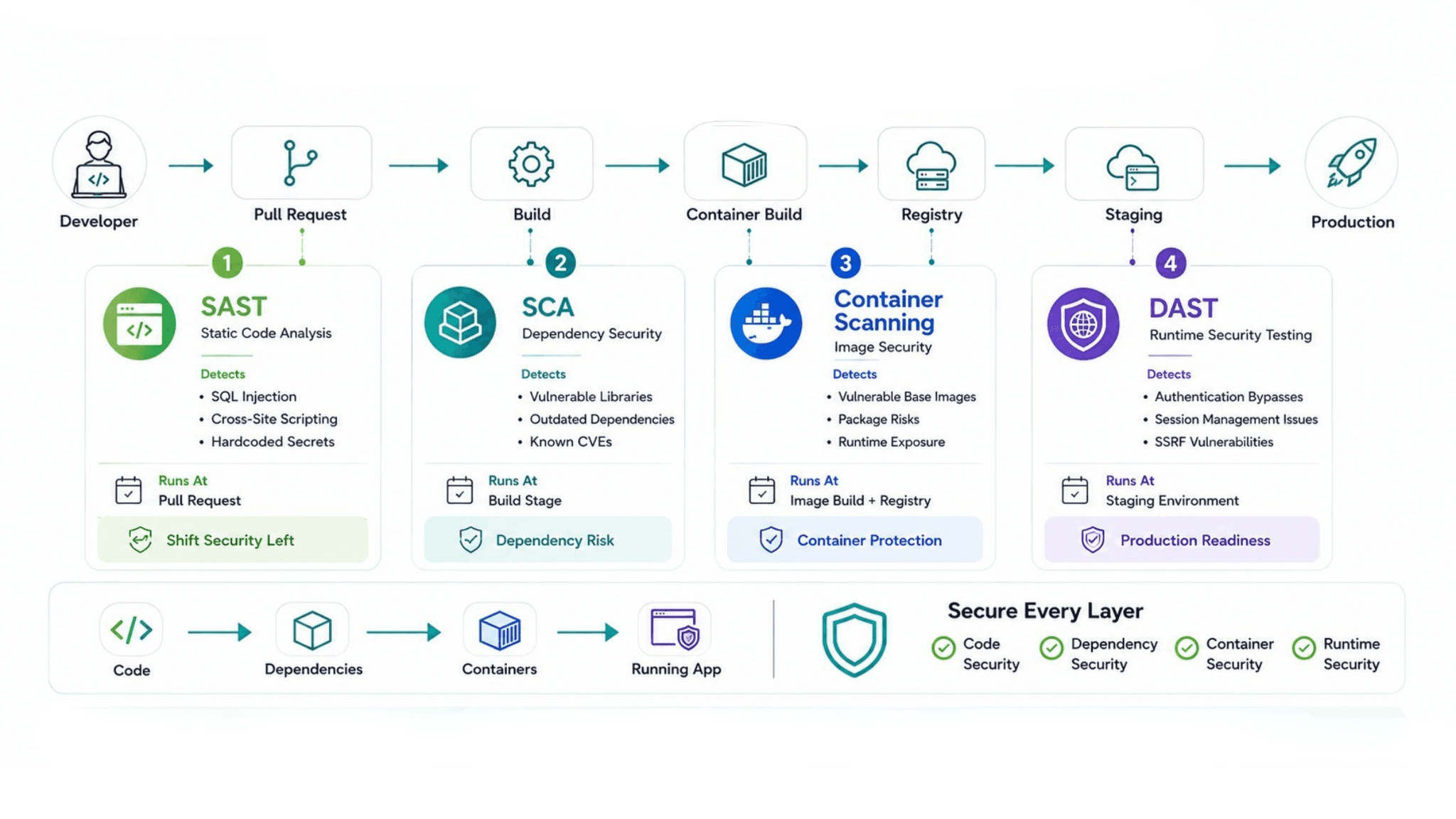
Four categories of security control, placed at the correct pipeline stage, cover the primary classes of vulnerability that DevSecOps programs are designed to catch. Each control has a specific placement that determines whether it produces actionable feedback or just generates a report nobody reads.
Static Application Security Testing (SAST) analyzes source code without executing it, identifying patterns associated with security vulnerabilities: SQL injection, cross-site scripting, insecure deserialization, hardcoded credentials. SAST belongs at the pull request stage. The scan runs when the PR is opened, results appear as PR comments, and the developer who wrote the code receives the feedback before anyone else has reviewed the PR. Tools in this category include Semgrep, SonarQube, and CodeQL.
Software Composition Analysis (SCA) scans the third-party libraries and dependencies your application uses against databases of known vulnerabilities. A library that was safe when you added it six months ago may have a critical CVE today. SCA belongs at the build stage, running against the dependency lock file every time the build executes. Tools include Snyk, OWASP Dependency-Check, and Trivy's library scanning mode.
Container Image Scanning checks the Docker images your application runs in for vulnerabilities in the base image, installed packages, and application layers. Container scanning belongs at two stages: at image build before the image is pushed to the registry, and at the registry level where new CVEs discovered after the original scan trigger re-evaluation. Trivy and Grype are the most widely adopted open-source tools.
Dynamic Application Security Testing (DAST) tests a running application by sending requests and analyzing responses for security weaknesses that static analysis cannot find: authentication bypasses, session management flaws, server-side request forgery. DAST belongs at the staging environment stage after deployment, not in the CI build where there is no running application to test. Tools include OWASP ZAP and Burp Suite Enterprise.
The placement matters as much as the presence. Integrating SAST tools into CI/CD flags insecure patterns before deployment, accelerating pipelines by catching issues cheaply upfront. 43% of organizations lag in AppSec maturity despite AI-driven velocity increasing the volume of code being written.
P99Soft's DevSecOps Consulting practice implements these four controls in the correct pipeline sequence, tuned to your codebase and your team's tolerance for false positives before blocking behavior is enabled. The tuning step is what most generic DevSecOps implementations skip, which is why they produce noise rather than signal.
The Reason DevSecOps Implementations Fail
Most DevSecOps programs that fail do not fail because the tools are wrong. They fail because the implementation produces friction without producing trust, and the engineering team routes around the friction as fast as possible.
The three most common failure modes are specific and avoidable.
Enabling blocking behavior before tuning false positive rates. Every SAST tool produces false positives. If you enable a rule that blocks PRs and that rule fires incorrectly on legitimate code five times in the first week, engineers will find a way to skip the check rather than investigate it every time. The correct sequence is: run in report mode first, tune the ruleset until false positive rate is low, then enable blocking behavior. This sequence takes two to four weeks and makes the blocking mode trusted rather than resented.
Running all scans sequentially rather than in parallel. A pipeline that runs SAST, then SCA, then container scanning, then DAST one after another adds the total scan time of all four stages to every build. A pipeline that runs SAST, SCA, and container scanning in parallel at the appropriate stage adds only the time of the slowest scan. The difference between a 4-minute security overhead and a 25-minute security overhead is what determines whether engineers commit frequently or batch their work to avoid pipeline runs.
Treating security findings as a security team problem rather than an engineering team problem. When SAST results route to a security team's ticketing system and engineers receive no feedback until a ticket is created, the feedback loop is too long to be useful. Findings need to appear in the PR where the code was written, assigned to the engineer who wrote it, with enough context to act on without a security team translation layer. 92% of organizations report improved security posture with DevSecOps adoption when security feedback reaches developers directly in their workflow.
How Observability Connects to DevSecOps
Security in the pipeline catches problems before they reach production. Observability catches the problems that reach production anyway.
A mature DevSecOps practice needs both layers. The pipeline layer prevents known vulnerability classes from reaching production. The observability layer detects anomalous behavior in production that might indicate a successful attack or a vulnerability the pipeline did not catch.
Observability Implementation connects to DevSecOps specifically through security-relevant telemetry: authentication failure rates that spike before a credential stuffing attack becomes visible, API error patterns that indicate probing behavior, and unusual resource consumption that might indicate cryptomining or data exfiltration.
Prometheus Consulting adds the metrics collection layer that feeds security alerting. A Prometheus alert rule that fires when failed authentication attempts exceed 100 per minute per IP address is a security control implemented in the observability stack rather than the pipeline. These two layers work together: the pipeline stops known-bad code from deploying, and the observability stack detects behavior that known-bad code would produce if it somehow got through.
Grafana Solutions provides the visualization layer that makes security telemetry actionable. A security dashboard that shows authentication failure rates, certificate expiry timelines, vulnerability scan results over time, and deployment frequency alongside change failure rate gives engineering and security teams a shared view of the security posture in real time rather than in a monthly report.
A Practical DevSecOps Implementation Sequence
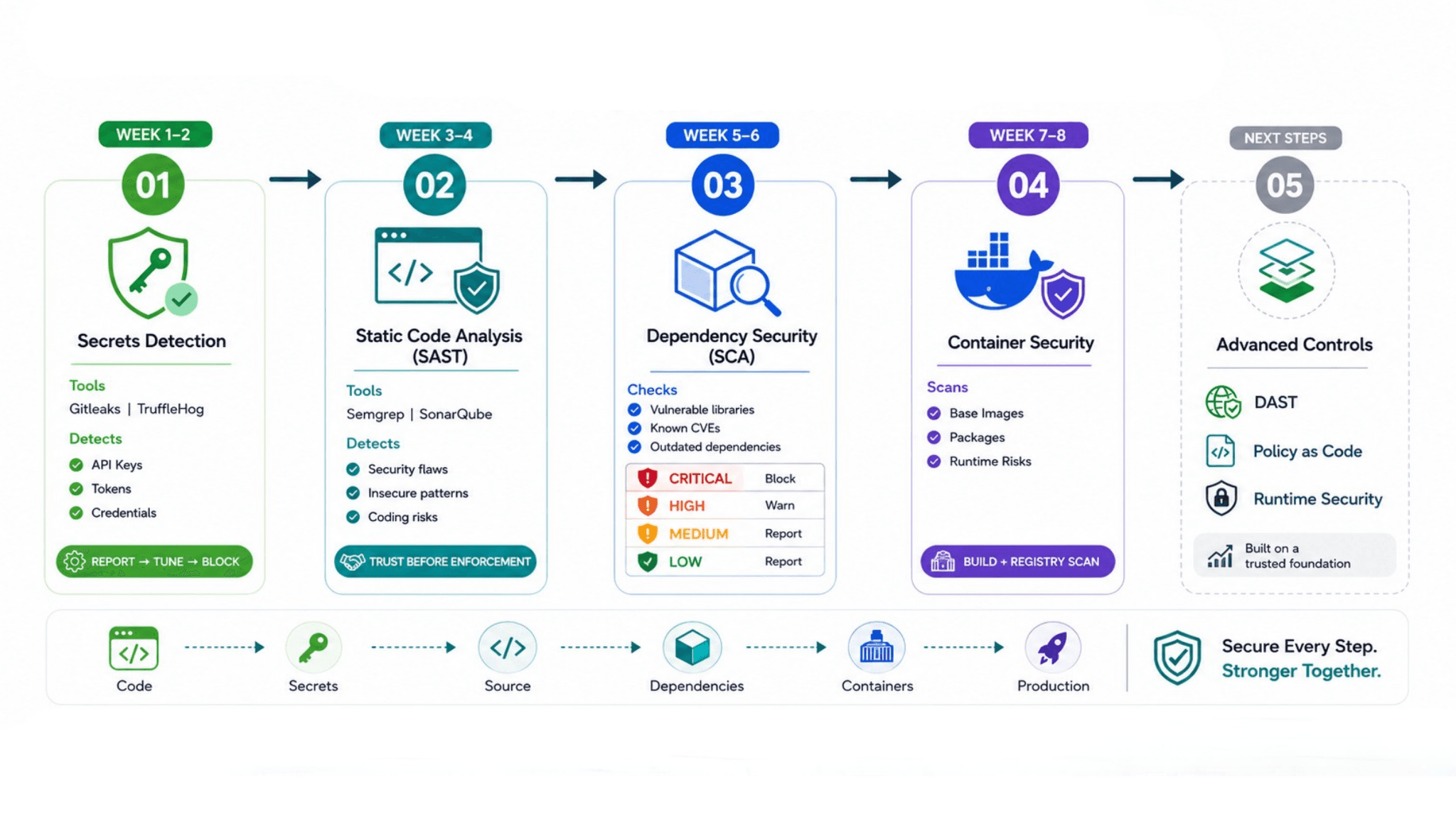
A DevSecOps implementation that works does not require a six-month platform program. It requires a deliberate sequence that starts with one control, validates it, and expands from there.
Week 1 and 2: Secrets detection. Add a secrets detection scan to the PR pipeline. Gitleaks or TruffleHog scan every commit for patterns that match API keys, database credentials, private keys, and tokens. Run in report mode first. Tune out false positives from test files and example configurations. Enable blocking behavior. Total implementation time: a few hours of engineering work.
Week 3 and 4: SAST. Add Semgrep or SonarQube to the PR pipeline. Start with the default rulesets for your primary language. Run in report mode for one week. Review the results with the engineering team, identify which rules are firing on real problems versus false positives, and tune the ruleset. Enable blocking only on the rules the team agrees are high-confidence. This process builds engineering trust in the tool before it has the power to block their work.
Week 5 and 6: Dependency scanning. Add SCA scanning at the build stage. Configure it to block on critical CVEs with known fixes. Warn on high. Report on medium and low without blocking. Set up a weekly review of the dependency report so the team has visibility into accumulating risk without being overwhelmed by noise.
Week 7 and 8: Container scanning. Add image scanning at the build stage before the image is pushed. Apply the same severity policy as dependency scanning. For organizations already running containers in production, run a one-time scan of all existing images in the registry to establish a baseline. The baseline scan result almost always surfaces CVEs that need immediate attention.
From this foundation, DAST, policy as code, and runtime security controls layer on top without displacing the earlier investments. Each stage produces value before the next begins.
FAQ
What is DevSecOps and how is it different from DevOps?
DevSecOps extends DevOps by making security a shared engineering responsibility throughout the development process rather than a separate gate at the end. DevOps integrates development and operations. DevSecOps adds security as a third discipline that belongs to the same team using the same pipeline, not to a separate security function that reviews output. The practical difference is that security findings reach developers in pull request comments rather than in audit reports, and fixes happen in the same sprint the vulnerability was found rather than in a separate remediation backlog.
What does shift left mean in DevSecOps?
Shift left means moving security checks earlier in the software development lifecycle, toward the point of code creation rather than toward the point of deployment or release. A vulnerability caught when a developer writes the affected code costs roughly 6 times less to fix than the same vulnerability caught in production. Shift left is implemented by placing security scanning tools at the pull request stage so developers receive feedback before their code is reviewed, merged, or deployed anywhere. The earlier the feedback loop, the cheaper and faster the fix.
How do you implement DevSecOps without slowing down engineering teams?
The key is implementing security controls in parallel rather than sequentially and tuning false positive rates before enabling blocking behavior. SAST, SCA, and container scanning can all run simultaneously at their respective pipeline stages rather than one after another, which prevents security overhead from adding sequentially to build time. Running each new security control in report mode for one to two weeks before enabling blocking behavior builds engineering team trust in the tool and prevents the friction that causes teams to route around security gates.
Which DevSecOps tools should engineering teams start with?
The three lowest-friction starting points are Gitleaks or TruffleHog for secrets detection at the commit stage, Semgrep for SAST at the PR stage, and Trivy for container and dependency scanning at the build stage. All three are open source, well-documented, and integrate with GitHub Actions, GitLab CI, and most other CI/CD systems in under a day of engineering effort. Starting with secrets detection first produces immediate value because hardcoded credentials are high-severity, high-frequency findings that every codebase has accumulated somewhere over time.
Author Name - Mrunalini Wankhede