Salesforce Integration: The 5 Patterns and How to Choose One
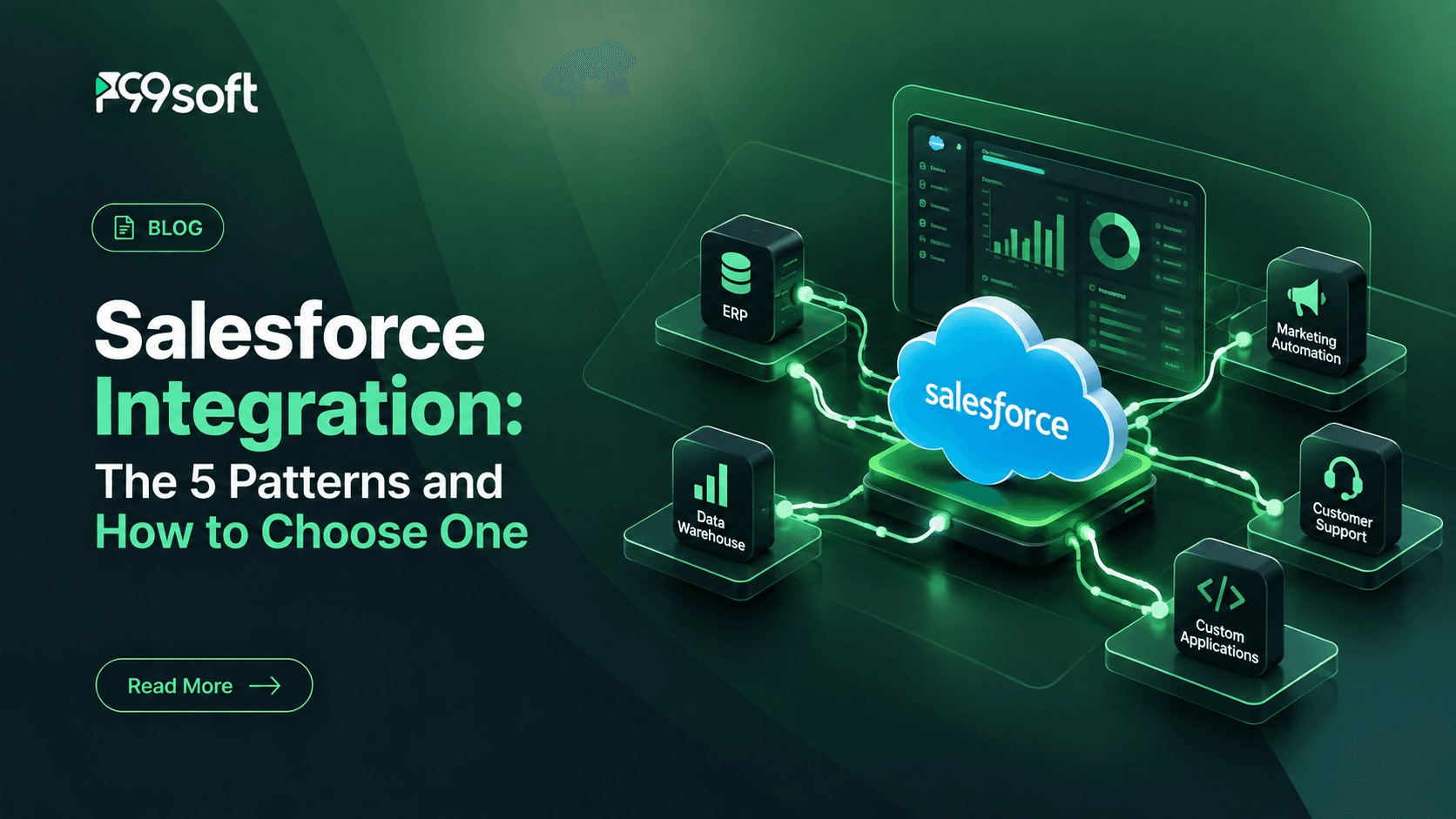
Salesforce integration connects Salesforce to systems such as ERP, billing, marketing and data platforms so information flows without manual entry. Salesforce's architecture guidance groups integrations into five patterns: request and reply, fire and forget, batch data synchronization, remote call-in and UI update based on data changes. Choose by timing, volume and which system starts the exchange.
What are the main Salesforce integration patterns?
Request and reply: Salesforce calls an external system and waits for the answer, such as a credit or stock check while a rep works. Use it when the user needs the result immediately.
Fire and forget: Salesforce sends a message and carries on, for example passing a won opportunity to billing. The other system processes it later.
Batch data synchronization: Large sets of records move on a schedule, such as a nightly load from an ERP.
Remote call-in: An external system creates, reads or updates Salesforce data through its APIs.
UI update based on data changes: Screens refresh when data changes, so users see updates without reloading.
Which Salesforce tools support these patterns?
Salesforce provides REST, SOAP and Bulk APIs, plus Platform Events and Change Data Capture for event-driven integration. MuleSoft, which Salesforce owns, supports managed integration at scale. Match the tool to the pattern: Bulk API for large batch loads, events for fire and forget, and the REST API for remote call-in. API limits apply per org and edition, so check Salesforce's current documentation before you design volumes.
How do you choose the right approach?
Ask four questions. Does the user need the answer now? How many records move, and how often? Which system owns each field, so you know the source of truth? What happens when a call fails? That last question decides how reliable the integration is. Use external IDs so repeated updates do not create duplicates, add retries and an error queue, and monitor failures from the first day.
Point-to-point connections multiply as you add systems, so put shared services behind a reusable API layer. Our piece on why integration is the next enterprise advantage explains the wider case. If you plan to unify customer data from many sources, read about Salesforce Data Cloud, and for project planning see our guide to Salesforce implementation strategy. P99Soft's CRM services and Salesforce consulting team design and build these integrations.
FAQs
What is the best way to integrate Salesforce with an ERP?
It depends on the data. Batch synchronization suits bulk master data, events suit status updates and request and reply suits live lookups. Most projects use a mix.
Do I need MuleSoft to integrate Salesforce?
No. Native APIs and events cover many cases. Middleware helps when many systems must connect and share rules.
What is the difference between the REST API and the Bulk API?
The REST API suits small, interactive requests. The Bulk API processes large volumes asynchronously.
Author Name - Mrunalini Wankhede